2018/11/21

Breton Language relay race fund several projects with 124,000 € collected


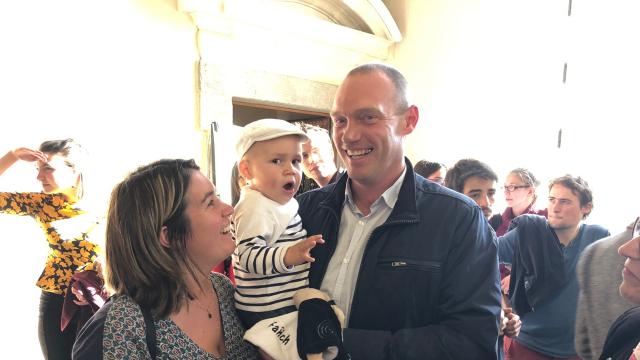
On Saturday, November 10th, in Ti ar vro, in Gwengamp/Guingamp, the official presentation of funding for projects in favor of the Breton language of Redadeg took place. The Redadeg is the relay race that crosses Brittany to promote the transmission of the Breton language and participates in the editing of many projects around the Breton language. In 2018, € 124,000 will have been collected through the kilometers of relays sold to individuals and businesses.

"We are in Ti ar vro for two reasons. The first is that the arrival of the 2020 edition will take place in Guingamp, the second is that Ti ar vro is one of the beneficiaries, "explain the organizers.

Thanks to the € 10,000 awarded by the Redadeg, the leisure center in Breton Ti ar vro is on track, since September 26, in the old school of Castel Pic. Supervised by Kadvael Jolived and two animators, the reception is every Wednesday for thirty children from 4 to 11 years. Seven other projects were supported, such as Radio Kerne for its radio project in Nantes; C'hwi a gano, web series in Breton or Bev.bzh and its social network dedicated to brittophones. The other beneficiaries are An Hentoù Treuz and his teaching tool Breton; Difenn, for his project against inequality; Addes, for a show for children and Mignoned ar Brezhoneg, for the ten years of Taol-Lañs.

Read more »

Duaisean na Gàidhlig – The Scottish Gaelic Awards 2018

SCILT’s Gaelic Professional Development Officer Eòghan Stewart was amongst a range of winners at Duaisean na Gàidhlig – The Scottish Gaelic Awards 2018 at the Grand Central Hotel in Glasgow on Wednesday 14th November.
Eòghan was awarded the prize for Innovation in Education, thanks to his involvement in Gaelic Learners’ resource Gàidhlig Gu Leòr which uses Apple’s Clips app to create short, snappy Gaelic learning videos.
Others honoured included rock legends Runrig who received the Urram nan Gàidheal (Honour of the Gael) Award and Professor Boyd Robertson (formerly of University of Strathclyde) and John Norman MacLeod for their work over many years for Gaelic, but over the last decade together at Sabhal Mòr Ostaig UHI.
The Awards were sponsored by Bòrd na Gàidhlig and the Daily Record.

Link


Read more »

2018/11/20

French court finally accepts Breton language name Fañch

A Roazhon / Rennes French court recognized yesterday the Breton name Fañch. It is a success for Breton movement after legal battle where the name was declared as threatening the unity of the state.

Read more »

2018/11/19

1st edition of the Breton Cultural Week from 19 to 24 November

From 19 to 24 November, the Université Bretagne Sud (UBS), in partnership with the association Emglev Bro an Oriant, organizes the first edition of the Breton Cultural Week to discover or rediscover the cultural wealth of the region. On this occasion, a fest-noz is held on Thursday, November 22 from 7 pm, Docks 1 and 2 at Pier 9 in Lanester. Also on the agenda, on 23 and 24 November, an international conference "Breton language, minority languages: future and family transmission". Throughout this week dedicated to Breton culture, many free activities are offered on the Lorient campus: tastings, exhibitions, conferences, workshops, selection of books ...

Link


Read more »

2018/11/18

Manx Gaelic Language festival to take place this weekend

A wide range of events are being held this weekend, to practice, promote and celebrate Manx Gaelic.
The 'Cooish' language festival seeks to provide speakers of all ability levels the opportunity to explore Manx in a relaxed, fun environment.
First up is 'Bee ec Greens' - a gentle introduction to the weekend with an informal dinner, at Green's restaurant in St John's from 7:30.
Nicola Tooms, who has gone from complete beginner to fluent Manx speaker in her adulthood, told Manx Radio what's up next, tomorrow morning (Sat 17)or more information, search Cooish, on social media.

Read more »

Thousands take part in Irish speaking marathon

Over 32,000 students took part in the annual #Gaeilge24 challenge today. Students in 340 schools across the country as well as participating groups abroad will take part in Conradh na Gaeilge’s annual challenge in which participants are encouraged to speak Irish for 24 hours.

“Gaeilge24 encourages a positive mindset towards the language in young people, by making it fun and relevant. It gives them an opportunity to see the ways in which they can incorporate Irish into their everyday lives, and leaves them with a positive experience of using the language,” says Dr Niall Comer, president of Conradh na Gaeilge.

Students from every county in Ireland participating in the challenge, which includes students attending English and Irish medium primary and secondary schools, will each receive a certificate for taking part.

Cillian Ó Braonáin, a teacher who organised Gaeilge24 in Coachford College, Cork said: “Gaeilge24 is a great cause for excitement in our school. We hold Seachtain na Gaeilge for the whole week, with Gaeilge24 at the heart of it. It is a great incentive for the students, who get great enjoyment out of it.
“There is always a demand for the wristbands and t-shirts, and the number of students wanting to take part increases every year,” he added.

This year, Gaeilge24 is one of the main school-based events being organised as part of Bliain na Gaeilge and groups across the 32 counties will undertake a challenge at 1.25pm to celebrate 125 years since the beginning of the revival of the Irish language.

Students raise money to pay for the support packs that they receive on the day, and any profit from the day goes towards the registered charity Conradh na Gaeilge to support the promotion of Irish throughout Ireland.

Read more »

2018/11/17

'Irish Gaelic Language, Resistance and Revival'

Dr. Feargal Mac Ionnrachtaigh's 'Language, Resistance and Revival' tells the untold story of the groundbreaking linguistic and educational developments that took place among Republican prisoners in Long Kesh prison between 1972-2000.

During a period of often bitter struggle between Republican prisoners and the British state, the Irish language was taught and spoken as a form of resistance during periods of imprisonment in the cages of Long Kesh (1972-1976), throughout the blanket protests in the H-Blocks (1976-81), and in the period just after the first and subsequent IRA ceasefires (1994-2000).

The book unearths this story through a series of interviews with prisoners, teachers and language activists, and analyses the rejuvenating impact it had on the cultural revival in the nationalist community beyond the prison walls.


Cultúrlann Uí Chanáin
37 Great James Street, BT48 7DF Derry, Northern Ireland

Read more »

2018/11/16

Irish language officer appointed for Múscraí Gaeltacht

An Irish language planning officer has been appointed for the Múscraí Gaeltacht in a bid to increase the level of Irish spoken daily in the Mid-Cork region.
Rosaí McCarthy will take up a three-year contract within weeks.
She was previously the language planning coordinator for local development cooperative Comharchumann Forbartha Mhúscraí in 2016-17, and was responsible for putting together the area’s language plan, which was given Government approval in May this year.
According to Census 2016, Múscraí is home to 3,785 people, 4% of the country’s total population in Gaeltacht areas of 96,090.
It emerged that across all Gaeltacht areas, only about 20,600 spoke Irish on a daily basis outside the education system, while a total of 63,664 were fluent.
The Múscraí Gaeltacht encompasses the villages of Baile Mhic Íre, Baile Mhúirne, Béal Átha ’n Ghaorthaidh, Cill na Martra, Cúil Aodha, and Réidh na nDoirí.
Ms McCarthy’s full-time appointment begins at the end of November and she will be responsible for leading the implementation of the area’s language plan, with €100,000 Government funding granted for its administration for its first year.
It is yet to be decided in which office in Gaeltacht Mhúscraí the language planning officer will be based. Although the manager of the co-operative has been based in Cill na Martra, that office may not be used to accommodate the language planning officer.
Comharchumann chairman Jerh Ó hÉalaithe said: “We are looking at options at the moment as to where they will be based.”
A new manager for the co-operative is also due to be appointed shortly after candidates for the vacant post were interviewed last week. Comharchumann committee members met last week to discuss the recommendations of an interview board after the job became available at the end of the tenure of former TG4 reporter Grett O’Connor, who was acting manager.
Ms McCarthy’s job as language planning officer will be focused on increasing the level of Irish spoken in Gaeltacht Mhúscraí.
Mr Ó hEalaithe said: “The aim is to have more people speaking Irish daily in the Gaeltacht.

Read more

Read more »

2018/11/14

Barristers warn police over Welsh language 'obligations'

Police must not 'shirk their obligations' to offer Welsh language legal interviews, barristers have said.
Standards imposed by the Welsh Language Commissioner include a duty to provide a simultaneous translation service if an interview cannot be conducted in Welsh.
Chief constables in Wales have complained this requirement is 'unreasonable and disproportionate'.
The Bar Council said police objections "do not stack up".
Currently if a Welsh-speaking officer is not available to conduct an interview in Welsh, police forces in Wales offer a "consecutive translation" service.
That means questions asked in English are translated into Welsh, before the response is translated into English.
The Welsh Language Commissioner wants translation to be simultaneously - as is done in court throughout Wales.
North Wales Police's Deputy Chief Constable, Richard Debicki, who leads on Welsh language for all four forces in Wales, said police were "making every effort" to provide a fully bilingual service to local communities.
However, simultaneous translation would require significant investment and could hamper investigations, he said.

BBC

Read more »

2018/11/12

The Irish language has been reinvigorated as young, secular and accessible

My name is Darach Ó Séaghdha. Don’t let the surname scare you– the gh is silent. So is the dh. However, the Sé has an invisible h tucked in there. It sounds like O’Shay, really.
So how did this happen to me? Well, my parents were, like so many people in south Dublin in the 1970s, very interested in the Irish language and they blessed us all with Irish names. I didn’t care for it much as a child and even less as a teenager; I felt like I spent more time spelling my name out to people than participating in any enjoyable activity. Once I was no longer required to study it, I moved away from the language. This rejection was particularly hard for my father to bear: he was multilingual but Irish was the language he loved best.


As the years went by I started to get a larger sense of missing out on something by abandoning Irish, along with a realisation that my father wouldn’t be around forever. After my wedding when he was too unwell to make a speech, I started re-examining Irish a bit more consciously. And I was delighted with what I found. It was a language full of broad humour, sly rhymes and one-word sonnets. It was loaded with earthy poetry and subversive wisdom. It was a language like my father.
Words like:
Mac Tíre: a wolf, literally “son of the country”;
Smugairle Róin: a jellyfish, literally “seal snot”;
Seordán: a rustling sound made by wind through leaves.


I started keeping a record of the amazing words I was finding in a Twitter account called @theirishfor. Within a few months, radio stations and news websites were putting out stories about the account and thousands of people were following it. I wasn’t an expert on the language but I had found an audience who wanted to feel the pleasure of Irish, away from the scars of school.
The pleasure of Irish in words like:
Seoraí: non-essential extra flourishes in storytelling;
Clannógach: having lovely hair or being very cunning… or both;
Athghnó: a job you have to do again because it was done badly the first time.
@theirishfor led to my first book, Motherfoclóir, a memoir about my father and the Irish language that won the Popular Non-Fiction Award at the Irish Book Awards in 2017. My second book, Craic Baby, takes up where Motherfoclóir left off. After looking back into my own memories and talking about what Irish meant to my Dad, I now wanted to write about what Irish will be like for my daughter (currently two years old) when she starts to experience it. How does this language of medieval kings and fishermen, of bards and peasants fit into a world of online slang and business acronyms, of Google Translate and Duolingo?

 he truth is that Irish is a modern European language and it has new words for new things, some of which are wonderfully clever.
Clever new words such as:
Turscar: Irish for spam email, from a word for dead seaweed left by the tide on a beach;
Éistphéist: an earworm, a tune you can’t get out of your head;
Tliongánach: a Klingon, derived from tlhIngan, the Klingon word for a Klingon.


The Irish language has been overly politicised on this island, especially along religious lines. This is a pity – it’s not this way with Scots Gaelic or Welsh. In the Republic at least, however, a drop in religious participation has not dragged the language down with it. Instead, the language has reinvigorated itself as young, secular and accessible. It turns up in memes, tweets and song lyrics while its critics declare it to be dead. Every week on the Motherfoclóir podcast I talk to people who are doing interesting things with Irish or pertaining to Irish – using it to write computer code, editing Irish language Wikipedia, studying the differences between the English and Irish versions of the constitution, getting new words added to the dictionary – and I’ve managed to share some of these stories in Craic Baby.
For me, our language is a treasure belonging to the people of Ireland and preserving it is as important as keeping Venice afloat is to the Italians. Like Venice, it contains visible history and public art, but also needs to be managed in a way where it can be fit for daily life. I’m happy to be a gondolier.


Source

Read more »