2018/11/11

Flags of the Celtic Nations

We have available each of the Celtic flags in 60 x 90 size as well as other sizes.
Please write to: nsestat@gmail.com

Ireland/Eire
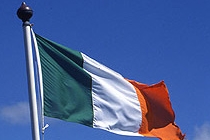
Irish flag
The national flag of Ireland (Irish: bratach na hÉireann) is a vertical tricolour of green white and orange. It has been regarded as the national flag since it was raised above the General Post Office in Dublin during the 1916 Easter Rising. This was the rising of Irish republicans against British rule and the flag has been used by nationalists in the whole of the island of Ireland since then. It was adopted in 1919 by the Irish Republic during its war of independence, then by the Irish Free State (1922 – 1937) and given constitutional status in 1937.
The flags origins date back to 1848. It was presented to Thomas Francis Meagher (August 3 1823 – July 1 1867) when in France by a group who were sympathetic to Irish aspirations for independence. Thomas Francis Meagher was a founder member of the Irish Confederation, an Irish nationalist independence movement formed in 1847.

Isle of Man/Mannin
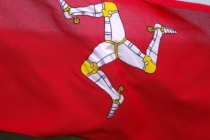
Manx flag
The national flag of the Isle of Man (Manx: Brattagh Vannin). The symbol can be traced back to both Celtic and Norse times. It is associated with Manannán the pre-Christian Celtic god who is part of the Gaelic  pantheon of the Tuatha Dé Danann. He was said in oral tradition to race down the Manx mountains on three legs.
The triskele symbol (as found on the Manx flag) is very characteristic of the three interlocked and conjoined spirals found in Celtic art throughout Celtic north western Europe. There are examples of such designs on Neolithic monuments in the Celtic lands, including in the Newgrange passage tomb in Ireland.  The design has continued to be used by the Celtic people who are directly descended from their Neolithic ancestors who lived in these lands. It is thought to be a symbol, of life, fertility, the seasons, the  universe and regeneration.

Scotland/Alba
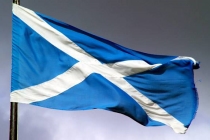
Scottish flag
The national flag of Scotland (Scottish Gaelic: Bratach na h-Alba) is a white cross against a blue background. It is known as the Saltire and legend dates its origins back to King  Óengus mac Fergusa (Óengus II) who defeated a force of invading Angles in the ninth century.  The legend is that in 832 AD the Scottish King prayed to St Andrew for help to defeat the English.  Against the blue sky the diagonal white cross appeared and it was on such a cross that St Andrew had been martyred.  The English were beaten and St Andrew is the patron saint of Scotland. The association of St Andrew with Scotland goes back further than the reign of King Óengus II to Óengus I who was King from 732 to 761 AD.
The Saltire features as part of the logo of the Scottish Government and the flag is ruled by them to fly whenever possible from its buildings on a daily basis.

Wales/Cymru
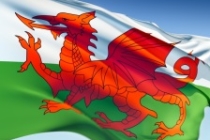
Welsh flag
The national flag of Wales (Welsh: Baner Cymru or Y Ddraig Goch) is a red dragon against a green and white background. There are a number of versions of how the red dragon has become the symbol of Wales. In one such story it has been associated with Arthurian legend and the wizard Merlin (Myrddin). Merlin prophesied to King Vortigern (Welsh: Gwrtheyrn) of Wales that the red dragon, being the symbol of the Celts, would defeat the white dragon which was the symbol of the Saxon invaders. The Saxons would then be driven from the land.


Cornwall/Kernow
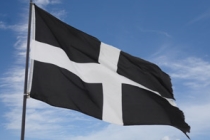
Cornish flag
The national flag of Cornwall (Cornish: Baner Peran) is a white cross against a black background. It is attributed to St Piran, now generally accepted as the patron saint of Cornwall. The flag of saint Piran is similar to the flag of St David (Welsh: Baner Dewi Sant), a yellow cross on a black background and the old Breton flag (Breton: Kroaz Du), a black cross against a white background and a symbol of the independent duchy of Brittany. There are clear and close cultural ties between Cornwall, Wales and Brittany.
Cornwall is located on a peninsula in the southwest of the island of Britain. It is one of the six Celtic nations and one of the three that share the island along with Wales and Scotland. The non-Celtic country of England is also located on the island of Britain. One legend of the early 6th century St Piran is that he came to Cornwall from Ireland sailing on a millstone. He is also associated with the metal tin and the flag of St Piran is said to symbolise the white metal flowing from black rock.

Brittany/Breizh
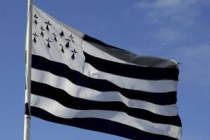
Breton flag
The national flag of Brittany (Breton: Gwenn-ha-du) has nine horizontal alternating black and white stripes with Ermine heraldry as used in the coat of arms of the  Duchy of Brittany. The flag is also used in the department Loire-Atlantique. The city of Nantes and the Loire-Atlantique Department were formerly part of the historic land of Brittany and Nantes along with Rennes was one of its traditional capitals. Historically, the country around Nantes was always seen as being part of Brittany. In 1207 the Dukes of Brittany lived in Nantes. Most of the dukes and duchesses were buried in the cathedral or the adjacent abbeys.
Although it was split from the other four departments that remain in Brittany by the French government, the Loire-Atlantique is culturally, historically and geographically united to Brittany. There continues to be active campaigns for the reunification of Brittany.

Pan-Celtic
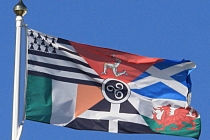
Celtic flag
The Pan-Celtic or Inter-Celtic flag is a combination of the flags of the six Celtic nations.

Read more »

2018/11/10

Klask, the Breton language shop, a site that exports the Breton language all over the world

In addition to marketing a multitude of cultural products in Breton, the Karaez site Klask also translates and publishes comics in Brezhoneg, the Breton language.  Klask.com is a commercial site created in 2006 by Tangi Ar Menn to market products in Breton language, be it books, DVDs or even stickers. The site offers for sale on-line 1,350 items. The initiative was born thanks to the founders of the company BZH5, created in 2000 to work in the computer world.

Read more »

2018/11/09

Cylch yr Iaith claims tourism industry is 'out of control' in Gwynedd

Language campaigners claim the tourism industry in Gwynedd is “out of control” and have urged councillors to take urgent action to address their concerns.

Cylch yr Iaith, a Gwynedd-based Welsh language pressure group, have written to all 75 Gwynedd councillors detailing their concerns and calling for a tourism policy which protects the character of local communities and the Welsh language.
Group spokesman Howard Huws said they believed the policies and regulations currently in force are no longer relevant and tourism projects are allowed to be developed in the county without the appropriate checks and balances.

He claimed major tourism related developments have been carried out during the last few years with little other development and said the imbalance had had a negative effect on communities.

In the letter to councillors, a copy of which has been seen by the Daily Post, the group states: “The county does not have a definition of the limits in regard to tourism developments and no monitoring and reviewing of the effects on communities. “There is a need for a policy which is much firmer with clear, unambiguous and consistent policies in view of developers, councillors and taxpayers.


Contact: Cylch yr Iaith
Talgarreg, Ffordd
Carneddi, Bethesda, Gwynedd LL57 3SG
cylch@tiscali.co.uk

Read more »

2018/11/08

Chance to learn Cornish songs for Christmas events in Liskeard

Cornish language and song sessions started on October 29th in Liyskerrys (Liskeard) as the town prepares for its Nadelik Lyskerrys Cornish Christmas event. The fun and informal workshops at the Albion pub are aimed at beginners and learners, and will continue every Monday from 7pm until the end of November.
The sessions are drop-in and there is no obligation to attend every week. A Helgh Gwyls (Wild Hunt) around the pubs with songs and storytelling will take place on December 1 following Liskeard’s lantern parade.

Read more »

2018/11/07

Anglesey farmer in TV licence protest appeals for broadcasting powers for Wales


William Griffiths had refused to pay his TV licence and argued that London control was a "threat to Welsh democracy".
He was given a six months conditional discharge and ordered to pay £220 costs.
A rally, organised by Cymdeithas yr Iaith Gymraeg was held outside the court building, from 9.30am, before Mr Griffiths was due to appear.
The 56 year-old from Bodorgan, is the second person to face a court sanction for refusing to pay the licence fee.
Another member of Cymdeithas yr Iaith, Heledd Gwyndaf, was sentenced in Aberystwyth last month.
There are over 70 people currently refusing to pay their TV licence fees as part of a campaign to devolve control over broadcasting from Westminster to Wales.
According to a YouGov opinion poll published last year, 65% of people in Wales favour devolving powers over broadcasting to the Senedd in Cardiff.
Speaking ahead of the court case, Williams Griffiths said:
“I’m very concerned about the lack of debate at a Welsh level and how that affects our democracy.
"Every day, broadcasters confuse people by reporting on matters that only affect England but giving the impression that they are relevant to Wales.
"The main broadcasters on all their platforms mainly produce content for England, from England for the benefit of England - we're being drowned in broadcast content that is damaging Welsh democracy. Devolving broadcasting powers to Wales is the only answer to these problems; and that’s why I’m taking a stand."
“This campaign goes to the heart of one of the main threats to our young system of self-government: if people don’t understand who’s responsible for what and what’s being done in their name, how can democracy work?
"The London-based broadcasting system threatens our Welsh democracy. I saw in the 2016 referendum the negative impact of the lack of discussion in the media about how the decision would affect Wales – we really needed more national scrutiny. It's been a massive problem in every referendum and election since devolution."
Aled Powell and the poet and musician Geraint Lovgreen, addressed the rally outside the court ahead of the hearing.
Mr Lovgreen said: "Many thanks to William for his bravery. I, like growing numbers of other people, are also refusing to pay for my TV licence until decisions about broadcasting in Wales are made by the people of Wales.
"The Welsh language and Welsh democracy are seriously suffering as a result of the Westminster-run broadcasting system at the moment.
Controlling our own media in Wales will give us a chance to see the world through Welsh eyes."
Last year, campaign group Cymdeithas yr Iaith presented their proposals for a devolved system of broadcasting.
It claims that tens of millions of pounds extra would be available to invest in Welsh content on TV, radio and online through devolution with control over the licence fee and a new tax on big new media businesses like Netflix, YouTube and Facebook.

Source

Read more »

2018/11/05

Language ambassadors part of Scotland’s first Gaelic tourism strategy

Developing a national “Gaelic spoken” badge as well as ambassadors for language are some of the measures in Scotland’s first Gaelic tourism strategy.
The five-year plan is aimed at boosting the use Gaelic in the tourism industry, using the language and culture as a “unique selling point” to market to visitors.
Among a range of actions set out in the document drawn up by national tourism body VisitScotland are plans to develop and promote a national “Gaelic spoken” badge.
Other actions include encouraging Gaelic musicians to take an ambassadorial role for Scotland and creating Gaelic hospitality ambassadors.
Setting up modern apprenticeships for using the language in hospitality also forms part of the strategy, as does supporting the promotion of bespoke Gaelic tour guides.
Culture, Tourism and External Affairs Secretary Fiona Hyslop launched the document at The Scotch Whisky Experience in Edinburgh.
She said: “The Scottish Government is committed to securing the future of the Gaelic language and this strategy focuses on the potential Gaelic has to add to the authentic experience we provide for our visitors.
“Tourism is one of our key growth sectors and, by increasing the profile of Gaelic in our tourism industry, we not only provide an authentic Scottish experience, but we also benefit the economy through attracting even more visitors to Scotland. This strategy aims to harness that potential.”
VisitScotland chairman Lord Thurso said Gaelic is “under used” to promote tourism, adding: “VisitScotland looks forward to engaging with partners and businesses to develop and market Gaelic as a tourism tool.”

Read more »

2018/11/04

The bilingual digital magazine parallel.cymru is celebrating 100,000 page views in its first year


The bilingual digital magazine parallel.cymru is celebrating a successful first year of publication, with 100,000 page views being viewed in that period.

Said Neil Rowlands, founder and project manager: "The purpose of parallel.cymru is to make the Welsh language and culture more accessible. This is done by presenting Welsh and English side by side, using a range of language registers (informal, formal and literary, and is completely free to access from any web browser anywhere in the world.

"I'm extremely happy that thousands of people have enjoyed reading the many articles and made use of the unique resources. Presenters like Huw Stephens and Eleri Siôn, and noted authors such as lexicographer D. Geraint Lewis, Welsh Valleys Humour's David Jandrell, Bethan Gwanas, Elin Meek and many more have written exclusively for the site. There's also resources such as a crowd-sourced map of shops, pubs and public places where Welsh is used, a bilingual grammar guide, interactive quizzes, plus some articles have been narrated so that people can read and hear the Welsh language at the same time.

"For the Welsh Government's goal of one million Welsh speakers by 2050 to be met, there is a need for us extend the reach of the language and present it in different ways. Parallel.cymru, as an independent not-for-profit organisation, captures this spirit and energy.

"Over 140 people have provided content for parallel.cymru, and I am grateful for them supporting a new and different way of publishing. I look forward to supporting many more people contributing and helping more people to enjoy our beautiful language in an inventive new way."

Garmon Gruffudd, Managing Director, Y Lolfa, said: "It's great to see how Parallel.cymru has developed over the last few months to become an indispensable website for learners and an important source of information and materials for people who want to keep a finger on the pulse in Wales. It has been a pleasure to work with Neil and the crew, and as a publisher we really appreciate that they offer a new, easy to reach platform to discuss our work and we very much congratulate Neil on reaching 100,000.


Cymraeg

Read more »

2018/11/03

‘Gaelic Education and Language Planning’ Presentation and Scottish Society AGM

The presentation will explain the background to Gaelic Medium Education and discuss some of the current topics and questions surrounding Gaelic education that are of interest. It will also explore some of the academic research and practical difficulties that have been encountered while implementing a Gaelic Language Plan.
The Scottish Society AGM will be held on November 17th after the presentation and all CIOL members living and working in Scotland are welcome to attend.

Lunch

Scottish Society committee members will be meeting for lunch before the talk and attendees are welcome to join. Please select ‘Optional 2 course lunch at Elia Restaurant’ if you wish to attend the lunch. You will be asked to choose your first and second course during the registration process.
Address:
Elia Restaurant
24 George Square
Glasgow G2 1EG

Programme 10/17/2018

12:45 Lunch at Elia Restaurant
14:00 ‘Gaelic Education and Language Planning’ by Andrew O’Halloran
15:00 AGM
Once the event has concluded, Scottish Society committee members usually go for a drink at a nearby café or pub. Please feel free to join us if you have some time available as this is a great opportunity for networking with students and fellow linguists.

Speaker bio

Andrew O’Halloran has been a modern languages teacher for twenty years and works at Annan Academy in Dumfries and Galloway. He holds a Postgraduate Diploma in Gaelic Medium Education. He is the author of the Dumfries and Galloway Gaelic Language Plan, for which he has day to day responsibility.

Read more »

2018/11/02

Rally in Caernarfon: member of Cymdeithas yr Iaith goes to court for refusing to pay for his TV license fee

William Griffiths Court Case: The Campaign for Broadcasting Devolution of Wales. A member of Cymdeithas yr Iaith, William Griffiths, goes to court for refusing to pay for his TV license fee as part of the campaign to devolve broadcasting powers for Wales. Bring the rally to support it before its court case:

9.30am, Monday, 5th November
Llys Caernarfon, Llanberis Road, Caernarfon LL55 2DF

You can join the boycott from the TV license fee by going to:
cymdeithas.cymru/datganolidarlledu or contribute to the financial fund to support the campaign by going to: cymdeithas.cymru/cyfrannu


Read more »

2018/11/01

Next Breton language race scheduled from May 15 to 23, 2020


On Saturday October 27th, in Ti ar Vro, in Karaez(Carhaix), the organizers of the Redadeg, meet in general assembly, and decided the names of the cities of departure and arrival for the next edition of the race in favor of the Breton language, which is to be run from May 15 to 23, 2020. The two lucky ones are: Karaez, for the start, and Gwengamp (Guingamp), for the finish.

"These two cities are very geographically close to each other," said co-chairs Leila Simon, Gerald Ar Gov and Thiffaine Siret. It is also a real asset for the success of the race. In the past, we have been accustomed to appreciating the professionalism with which the local committees organized the passage of the race on their territory ".
"Carhaix is ​​a city particularly involved in the defense of the Breton language for decades, with a complete network of teaching, Div yezh, Dihun, Diwan, generalized bilingual signage, and many events throughout the year. favor of the Breton language, "added the organizers. The course ? "For now, it is not finalized yet, what we can tell you is that after Karaez the witness (ar vazh) will go through Trégor, Léon, the country of Nantes, the country Vannet and will pass by Saint-Brieuc before joining Guingamp, city of arrival ".

The previous edition was 1,800 kilometers, the next could well exceed this figure. "It all depends on the number of volunteers in each city. From edition to edition, it is growing, so why not 2,020 km for the 2020 edition! "Amuse" the former "of the team, Gerald ar Gov. The funds raised by the sale of kilometers will be used to finance various projects highlighting the Breton language. "The real novelty of this next edition is the arrival in the team of hypermotivated young people, to whom we will pass the witness". Far from running out of steam, the race for the Breton language, the Redadeg found a second wind. Breath, it will take to rally Carhaix to Guingamp.

Read more »