2018/02/28

Hunger strike for broadcast powers ends on Senedd steps

A young campaigner has brought his seven-day hunger strike to an end outside the Senedd in Cardiff Bay today with an appeal for politicians to back the devolution of broadcasting powers to Wales.
Elfed Wyn Jones from Trawsfynydd has not eaten since last Tuesday as part of a campaign to transfer powers over broadcasting from Westminster to Wales.
The end of the fast came a day before a debate in the Assembly chamber on the matter, and the student presented a letter to the Welsh Government on the Senedd steps.
Speaking at the end of his seven-day stint without food, Elfed Wyn Jones said that the hunger strike “had not been easy” but that it was part of his “responsibility as a citizen of Wales”.
“I genuinely think that this is a crucial question for our democracy in Wales. If people don’t get the right facts about who is making decisions in their name, if they don’t understand how they’re governed, our young Welsh democracy is in serious danger.
“At the moment, fewer than half the population realises that the Senedd in Cardiff runs health, despite twenty years of devolution.
“Decisions about broadcasting in Wales have to be made in Wales if our politicians are to be held properly accountable for their actions.”
According to the results of a YouGov survey held last year, 65% of people in Wales support giving broadcasting powers to the Assembly while only 35% want politicians in Westminster to retain the power.
‘Inspire’
Heledd Gwyndaf, Chair of the campaign group Cymdeithas yr Iaith, said that Elfed Wyn Jones’ actions had “inspired a lot of people” and “kick-started a wider national debate”.
“A number of Assembly Members have also shown support over the years,” she said. “It’s time they now did something.
“As representatives of the people and as leaders of our country, they should take responsibility, pull their socks up and follow in Elfed’s brave footsteps and all those others who are prepared to break the law for this cause.
“Over fifty people are already refusing to pay their TV licenses as part of this campaign.”
An independent review of S4C is expected to be published soon. It is due to consider, among other issues, whether the responsibility for S4C should be devolved from Westminster to the Assembly.
A delay in publishing the conclusions of the inquiry, which were presented to the UK Government before Christmas, means the broadcaster does not know what its budget will be from April.
In 2013, the Silk Commission – a cross-party review commissioned by the UK Government – concluded that control over the government’s financial contribution to S4C should be transferred from Westminster to the Welsh Government.

Source

Read more »

2018/02/27

Conradh na Gaeilge Ard-Fheis


From 23th to 25th of February Conradh na Gaeilge's Ard-Fheis took place in Trá Lí, Co. Chiarraí. The League celebrated 125 years and supported an Irish language act for Northern Ireland and the March 3rd 'Gaeilge Bheo' activities under the motto 'Irish belongs to us all'.

Read more »

2018/02/26

Stéphanie Stoll, Breton speaker of the year

Stéphanie Stoll hasbeen awarded "brittophone of the year". A prize that rewards the commitment of this resident of Louannec in favor of the Diwan network, which she chairs. "I accepted this recognition because it goes to the entire Diwan network, explains the one who has been in charge since 2015. Together we managed to preserve the 152 contracts helped in Diwan last September. But next year? "
Coming from a family where the use of Breton was eroded over time, the granddaughter of the publisher Éditions Jack (postcards) decided to tame the language at the age of 25 years. "As much as my stays abroad had allowed me to make incredible progress in Spanish and English, the learning of Breton has proved to be destabilizing: how to learn it when the opportunities to be immersed in it on a daily basis are non-existent? "

After Sciences Po and a master's degree, the young woman embarked on a 10-week training course, which she perfected to the rhythm of evening classes, rehearsals in a theater troupe in Breton, conversations with the old neighbor ... To these difficulties, this mother of 3 children opposes the virtues of immersion, "a real chance for young people today." This will be the starting point of his associative commitment: the creation of a Diwan school in his commune, in 2006. "At that time, my Breton was still wobbly! Laughs this child from Louannec, near Perros-Guirec. Approximately or not, Breton is mastered by only 20% of the parents of Diwan's 4,300 students.

"We do not need to speak the language to measure the strengths of Breton education," says Diwan network president. Driven by a constantly rising demand, it is still preparing for new openings (several schools, a college and a high school).

Read more »

2018/02/25

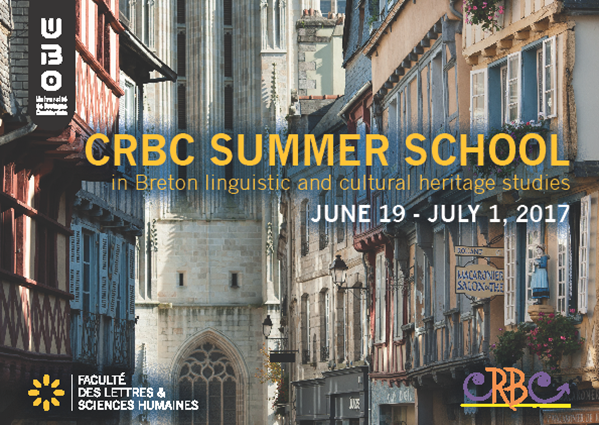
CRBC Breton Summer School Programme 2018


Teaching activities and lectures take place from Monday through Saturday morning (Saturday afternoon is free). The days are divided into two parts with morning classes being devoted to Breton language instruction. Afternoons are reserved for lectures and field trips. In addition, a number of dinners and evening activities have been planned.

The language classes are organized in three levels. Level 1 is designed for complete beginners, level 2 for false beginners and level 3 for intermediate learners. Conversation classes for all levels are taught by teachers from the Mervent Breton language Association. They concentrate their teaching on the spoken language.

Levels 1 and 2 are taught by Mr. Tanguy Solliec (linguist and PhD researcher specializing in Breton dialectometry, University of Western Brittany, CRBC). Ms Myrzinn Boucher-Durand (MA, University of Western Brittany, CRBC / PhD researcher, Celtic Studies, Harvard University) teaches the level 3 group. She will be residing at the Résidence les Colverts and accompanying participants throughout the two-week course as well as the Breton typology workshop and the Celto-Slavica 9 Colloquium.


June 4 to June 16, 2018


MORNINGS


9:00 to 12:30 – Breton language classes


The language classes are organized in three levels. Level 1 is designed for complete beginners, level 2 for false beginners and level 3 for intermediate learners. While the spoken language is stressed, the entire course has supports in standard written Breton with grammatical explanations in English. The Breton language lecturers are also English speaking (for afternoon activities, see below).


12:30 to 13:30 – Lunch (at the University Restaurant)
AFTERNOONS


13:30 to 16:15 – Breton culture and society

Lectures


The afternoon lectures are delivered by leading scholars in their fields. All lecturers are members of the CRBC.


A broad range of talks are proposed dealing with a variety of subjects such as Breton history, the origins of the Breton language, Breton dialectology and sociolinguistics, ethnology (rural and maritime culture), oral Breton literature (sources of the Barzaz Breiz), onomastics, Breton-language literature (medieval and modern), Breton art…


New talks and activities are planned for those who attended the Summer School in 2017 including a newly designed, hands-on workshop in Breton dialectology in which participants will analyse CRBC field recordings of native Breton speakers. This activity is organized by specialists in Breton geolinguistics.

OUTINGS


• During the first week of your stay, a visit of medieval Quimper and its cathedral will be organized.
• A visit to Locronan and the study of the gwerz of Saint Ronan and the origins of the Troménie and its connection with the forest of Nevet (< nemeton).
• The Art Gallery of Pont Aven and the discovery of the fishing village of Doëlan and the fortified seaport town of Concarneau.
• The 5th century monastery of Landevennec in the Crozon peninsula and a lecture of the origins of the Breton saints.


EVENING ACTIVITIES


Several evening meals will be offered to participants in Quimper and in Doëlan. The well-known traditional singer, Brigitte Kloareg, will introduce participants to Breton and Celtic singing and dancing. Every year, a favorite evening activity is to meet for a drink at the Ceili, a popular pub where Breton beer and cider are on offer and Celtic music is the rule. Quimper is known for its excellent restaurants.

Breton typology workshop and the Celto-Slavica 9 Colloquium

During the week following the Summer School, two exceptionnal events will take place : a workshop en Breton linguistic typology (June 19 - 20) and the Celto-Slavica 9 Colloquium (June 21-23). Both workshop and Celto-Slavica Colloquium will host many of the world's leading authorities in Celtic Studies.

Source

Read more »

2018/02/24

Anger over vandalism to bilingual welcome sign in Tyrone

Sinn Féin MLA Colm Gildernew has condemned the deliberate damage to an Irish language road sign outside Caledon. The Fermanagh South MLA said: "The vandalism of this sign is indicative of the attitude of some in society who show a complete disregard and lack of respect for the Irish identity. "There is no excuse for this type of vandalism and it will not be tolerated.

"Anybody removing, destroying or vandalising bilingual signs is involved in criminal damage and should be reported to the PSNI.Occurrences like this bring into focus the need for protection of Irish Language rights through Acht na Gaeilge." Sinn Féin and SDLP councillors recently hit out at vandalism of a bilingual road sign at Glenone area of Portglenone in Mid Ulster district.

Read more »

2018/02/23

Welsh hunger striker wants to take back the media

Elfed Wyn Jones is already more than a day into his week-long hunger strike when he speaks to i by phone. “I’m alright,” he says, by way of reassurance. The 20-year-old farmer and student’s cause is not one that most people outside of Wales will have given much thought to: he wants control over broadcasting devolved to Wales. But to Wyn Jones, it’s vitally important.

“We need a Welsh perspective to make democracy more transparent between the people of Wales and the Senedd,” he says. “For example, 50 per cent of the people of Wales think the NHS is run by London when it’s a fully devolved matter.

“That’s because of the confusion the media causes. People still think the Tories run the NHS here.” Wales is conspicuously behind other parts of the UK when it comes to media, with only one national newspaper (mainly sold in the south) compared to Northern Ireland, which has three despite having only 60 per cent of the population.

S4C, the Welsh-language version of Channel 4, is run out of Cardiff, but its budget is still set in London, and it has been cut by £50m between 2011 and 2018. A review announced last year is expected to be published soon – making it a key moment for its future direction. Westminster’s Department for Media Culture and Sport told the Daily Post that “it is right that the UK government retains responsibility for the sector”, so the prospect of a vast, devolutionary overhaul seems remote. “I believe we needed something to jolt it back into the media,” says Wyn Jones.

Wyn Jones’ is not the first hunger strike in the history of Welsh nationalism. Gwynfor Evans, a major figure in Plaid Cymru for decades, threatened his own if Margaret Thatcher reneged on a plan to set up S4C in the first place. Other students have mounted one-day strikes for the current cause, while Plaid’s Hywel Williams even launched his own one-day version to mark a hundred years of women’s suffrage earlier this month. But it’s not the resonance – either with Welsh history or Ireland or further afield – that inspired Wyn Jones.

“It was not because of historical reasons,” he said. “It’s purely practical, fast and kind of shocking too.” It’s an interesting juncture for Welsh nationalism at the moment, with Brexit closing down the “independence-in-Europe” option previously favoured by Plaid Cymru, and with arguments over whether Westminster or Cardiff get the powers repatriated from Brussels. “Especially with Brexit and the democratic processes between Westminster and the Senedd, this was the crucial time for us to have our own media so we can assess how all these political programmes will affect us here in Wales,” says Wyn Jones. “The only way we’ll do that is through our own media. I thought that by doing this protest, it will be a start.” For inspiration, he looks not to Scotland, with its more established media but weaker language programme, but to Catalonia and the Basque country, where regional languages have held their own against Castilian Spanish.

“It’s an inspiration what’s happened there since the 1980s when they had just one channel, like Wales,” he says. “If you look at Catalonia, they’ve got six TV channels and four radio stations in Catalan. It’s to do with every aspect, there’s something for everybody within that range of channels, for different age groups and different people within their society. “The Basque country also has six television channels. You’ve got two Basque channels, one for young people and one for everyone else, and then you’ve got a range of bilingual channels which introduce people to the Basque language. Those channels also give different perspectives and show the democratic processes clearly within those countries.”

Plaid Cymru, which has four MPs and 10 Assembly members, acknowledged the hunger strike and the issue behind it in a press release. “With broadcasting policy and funding all decided in Westminster, Welsh citizens are forced to watch domestic news that is almost solely focused on the domestic affairs of another country, and denied the public service for which they are paying,” said Liz Saville Roberts, the party’s Westminster leader. Plaid Cymru’s goal is independence, but Wyn Jones himself denies that his own action is part of a plan that eventually leads to Welsh independence.

“At the moment, it’s just to get better democracy to Wales,” he says. “We don’t want to think too far ahead. It’s better just to concentrate on devolution of Welsh broadcasting so we can get a clear understanding of our politics.” He also has the support of Cymdeithas yr Iaith Gymraeg (the Welsh Language Society), which has been taking part in direct action since the 1960s, when it ripped down English-only road signs and delivered them to the authorities. It has been described as the largest protest group since the Suffragettes in terms of numbers sent to prison.

Wyn Jones saw the Welsh flag at the United Nations in the latest Marvel superhero film Black Panther – and he was a fan. “It puts a smile on every Welsh person’s face to see Y Draig Goch, the Red Dragon, in something like that,” he says. “I like things like that, because it puts things into perspective and makes people think more about the future of Wales within the United Kingdom and the role it plays in the world. “Although some people say it’s insignificant, it does spark the mind a little bit to think deeply about things.” Wyn Jones will be hoping his own surprise for Wales will help focus minds on broadcasting.

Read more »

2018/02/22

‘Gaeilge le Chéile’ : Recognition of the Irish Language Speaking Communities outside of the Gaeltacht

For the first time in the history of Ireland official national recognition will be bestowed on communities outside of the Gaeltacht who support the daily use of the Irish Language in their community.
Five communities have been chosen: Belfast, Co. Antrim; Loughrea, Co. Galway; Carntogher, Co. Derry; Clondalkin, Co. Dublin; and Ennis, Co. Clare, to submit an application to the Minister to be officially recognised as an ‘Irish Language Network’ community/area.                     
The Minister for Culture, Heritage and the Gaeltacht, will bestow the official recognition of an ‘Irish Language Network’ on the communities when an Irish Language Plan, a plan which will be implemented over 5-7 years, has been agreed with the Department for Culture, Heritage and the Gaeltacht, and Foras na Gaeilge.
An imaginative public campaign has been created to inspire and encourage communities to use more Irish every day. ‘Gaeilge le Chéile’ –  Three easy steps: Use Irish every day, everywhere, with everyone.
“Simply what we hope to achieve is that more Irish will be heard and seen in our communities through creating and encouraging more opportunities to use Irish every day in our lives, starting with the easy step of using ‘Go raibh maith agat’ and ‘Slán’ every day, everywhere, with everyone.  Our communities will benefit from this planning process and future investment as a result”, Brian Ó Gáibhín, Clondalkin Líonra.
‘Gaeilge le Chéile’ and ‘the Irish Language Networks’ was officially launched on Thursday 22 February 2018 in Croke Park at 11.00 a.m. by special guest Bernard Dunne. Minister Joe McHugh TD was also be in attendance.


Read more »

2018/02/20

Welsh language commissioner role 'facing axe by stealth'


The Welsh Government is trying to abolish the post of Welsh language commissioner "by stealth", campaigners have claimed.BBC Wales understands the commissioner Meri Huws has not had replies to letters to ministers reminding them that her term in office finishes in March 2019.
Cymdeithas yr Iaith Gymraeg warns there could be a period without a regulator.
Welsh Government said the process to replace her would begin "in good time".
Instead of a single figurehead, the Welsh Government launched proposals last summer to create a Welsh language commission to promote the language.
It is thought that the next commissioner to be appointed may be the last to take up the role.
Ms Huws is yet to receive a reply to her letter to First Minister Carwyn Jones in the autumn or the minister responsible for the Welsh language, Eluned Morgan, last month.
The lack of response, coupled with the fact that ministers are yet to state firmly what the future of the commissioner role is, prompted concern among campaigners.

"This is very concerning and very unusual," said Colin Nosworthy from Cymdeithas yr Iaith Gymraeg.
"There could be a period without a Welsh language commissioner at all, regulating and defending our language rights.
"This looks like some stealthy means of getting rid of the Welsh language commissioner despite the fact that most people who replied to the Welsh Government consultation said they shouldn't get rid of the job."
Ms Huws previously said she wanted to see evidence that any change to the current structure would lead to the strengthening of the Welsh language.
Ms Huws said she "trusts that the process of appointing the next commissioner is under way".
A Welsh Government spokesman said: "The minister has received a letter from the commissioner and is preparing a reply to explain that the work of preparing the process to recruit her successor is going ahead.
"The process will begin in good time to secure a new commissioner will be in his/her place by March 2019."

Source

Read more »

2018/02/17

Prizioù Dazont ar Brezhoneg 2018

The Breton Future Awards ceremony was held on Friday, February 16, 2018 in Karaez / Carhaix in the presence of Mrs. Lena Louarn, Vice President of the Regional Council for Languages of Brittany and President of the OPLB (Breton Language Public Office), M Christian Troadec, Mayor of Karaez and Mr. Mael Le Guennec, Director of France 3 Bretagne.

The ceremony, which gathered more than 350 spectators, was filmed by France 3 Bretagne at Espace Glenmor and was broadcasted on the program Bali Breizh.


Winners List


Read more »

2018/02/11

40 years of Breton language school celebrated in Gwengamp

The anniversary of the 40th anniversary of Diwan school in Gwengamp / Guingamp school began on February 10th, with the schoolchildren, of course, but also with the singer brothers Morvan, Henri and Yvon, who came as neighbors of Saint-Nicodemus. The forum day, organized as part of the establishment's open house, continued with stands on associative schooling; board games in Breton; an exhibition on the history of Breton and the evolution of Celtic languages; a lecture around the language and its fragility, led by Fanny Chauffin, teacher at Karaez/Carhaix High School and author of the book "Diwan, 40 years old already". Speakers from Carhaix High School, the support committee or the Diwan network, as well as numerous associations will also be present (Breton Cultural Center, Redadeg, theater troupe, etc.).

Read more »