2020/10/30

The Concise English-Irish Dictionary launched today


A new English to Irish dictionary will include translations of words such as coronavirus, pandemic, and banana bread into the Irish language.

The Concise English-Irish Dictionary will be launched by President Michael D Higgins, on Foras na Gaeilge’s Facebook Page, later today.

Joining the president will be a host of household names such as, Dara Ó Briain, Micheál Ó Muircheartaigh, and Mary McAleese as they share their experiences with, and grá for the national language.

The new dictionary contains 1,800 pages, over 30,000 entries, 85,000 word senses, and 1.8m words in contemporary English and Irish.

Produced by Foras na Gaeilge, the dictionary is the first major English-Irish dictionary to be published in over 60 years. Tomás de Bhaldraithe’s seminal English-Irish dictionary was published in 1959.

President Higgins said: “It was a privilege to launch the new English-Irish dictionary website in 2013 and I’m delighted to be able to celebrate the final stage of the project today, the Concise English-Irish Dictionary. 

"This dictionary follows on in a proud tradition of Irish-language lexicography, including famous works by Niall Ó Dónaill, Tomás de Bhaldraithe, and Pádraig Ó Duinnín.

The president said dictionaries are critical tools for any language community. 

"They allow communities to express themselves confidently and effectively in their own language, while also preserving the richness — the saibhreas — of a language. I congratulate Foras na Gaeilge, the dictionary team, and everyone who was involved in this historic achievement.” 

Some interesting additions include translations of banana bread (arán banana), social distancing (scaradh sóisialta), pandemic (paindéim), and coronavirus (coróinvíreas).

Chief editor Pádraig Ó Mianáin said of the new dictionary: “The New English-Irish dictionary brings Irish-language lexicography into the third millennium with its emphasis on currency in both Irish and English and its coverage of all levels of language use, from formal to informal and from written to spoken. 

"The new English-Irish dictionary has been online since 2013 and now attracts over 2m users worldwide annually, with over a quarter of them from overseas.

“When the online version was completed, production of a printed version began. In order to produce a one-volume dictionary, over a third of the content in the online dictionary, which contains 48k entries and 145k word senses, had to be left out and the remaining content had to undergo significant editing and reformatting. 

"We are delighted that the dictionary is now available, and to have this opportunity to launch it with the President today.”

Read more »

Farming 'vital as Welsh language stronghold'

Farming's importance to Welsh must be recognised in post-Brexit plans to support the industry, the man in charge of promoting the language has said. Welsh language commissioner Aled Roberts said funding had to be focused on helping family farms survive. Census figures suggest 43% of agricultural workers speak Welsh, compared with 19% of Wales' population.The Welsh Government said it wanted to help the sector ensure a sustainable future for the language .Mr Roberts was responding to the recommendations of a recent report about how farmers could help the government meet its goal of one million Welsh speakers by 2050. Before the pandemic, Farming Connect researchers held workshops across the country, visiting agricultural shows and the National Eisteddfod to canvass opinion. Eirwen Williams said the findings were timely given ministers were looking at designing a new system to replace EU agricultural subsidies.

She said the main theme was that people wanted to see support for family-run farms, which play a "vital" role in supporting Welsh.

It was said they do this by enabling families and young people to stay in rural areas, leading to thriving schools, businesses and the long-term sustainability of the language."Many felt there should be a cap on how much one business can receive - to hinder farms getting bigger and bigger," Ms Williams said. "And that there should be support mechanisms especially targeted at the smaller farms."Mr Roberts said he would write to the government to discuss the report's findings. "This sector is a stronghold of the language," he said. "As we consider the shape of things after Covid and after Brexit, there is a danger that this is not part of the consideration.

"Without the agricultural subsidies recognising the importance of the family farms to the Welsh language, there will be erosion."There's also a need for the government, through the crisis that we've been through, to actually ensure that support is given to maintain organisations that are important in rural life, such as the Young Farmers' Clubs."

The report also called for changes to the planning system to help keep young people in rural areas by supporting farm diversification and rural enterprises, as well as facilitating the building of new houses on farmland, particularly in areas where demand for second homes had pushed up property prices.

Measures are needed too, the report said, to protect Welsh place names to ensure the language and heritage remain visible. Young Farmers' Clubs (YFC) were praised for supporting and promoting Welsh and it was recommended the funding they get from Welsh Government be formalised.

Read more »

2020/10/29

Ruth Keggin Gell new Yn Greinneyder, Manx Language Development Officer

Culture Vannin is delighted to announce Ruth Keggin Gell as their new Manx Language Development Officer. In Manx, the role is known as Yn Greinneyder, ‘the encourager or motivator’, and Ruth’s focus will be to promote, support and facilitate the Manx language within the community, as well as to help deliver the Manx Language Strategy.

Yn Greinneyder also works to develop and lead adult language courses, classes, conversation groups and projects, and promotes Manx through social and traditional media.

Director of Culture Vannin, Dr Breesha Maddrell, commented: “We are delighted to welcome Ruth to the team – she brings great strengths relating to all aspects of what is a demanding role, especially in terms of teaching experience, community engagement and advocacy for the language. Our work is about partnerships with the community, and Ruth’s engaging personality make her ideally placed to connect with new audiences.”

Ruth holds a BA in Music from the University of York and a PGCE from the University of Cambridge. She has a wide breadth of teaching experience from one-to-one tutoring, classes and workshops, through to large-scale lectures, and has taught music and Manx to a wide range of age groups. An active performer, she has released two solo albums of Manx Gaelic songs to critical acclaim, and has brought Manx language and music to worldwide audiences through tours, festivals, and appearances in national and international media. Ruth is also part of an inter-Gaelic vocal project ‘Aon Teanga:Un Chengey’, which celebrates the linguistic and musical links between the Isle of Man, Scotland and Ireland.

On-island, Ruth is an active part of Manx language and music communities. She sings with the Manx Gaelic choir Caarjyn Cooidjagh and vocal ensemble Tallis Consort, and helps to support Yn Chruinnaght Inter-Celtic festival and the DESC Manx Folk Awards.

Ruth said: “As someone who wholeheartedly believes in the value and importance of the Manx language, I am honoured to have been given the opportunity to become Yn Greinneyder. I am looking forward to working together with other groups and individuals who work hard to support and promote Manx, as well as collaborating with members of the team at Culture Vannin. I am excited to welcome new people to Manx, alongside celebrating those who already have a deep love for the language.”

The Manx language is one of the Island's most important cultural assets; it is an Island success story and something in which we all can take great pride. The Isle of Man is now looked to by many as an example of best practice internationally. Well-organised community based initiatives and targeted Isle of Man Government support over many decades mean that the Manx language is available for all ages to enjoy, within nurseries, schools, adult classes and the wider community. It is also a unique identifier for the business community and for the Isle of Man as a whole.

Ruth will initially work part-time before moving to full-time hours at the end of November. She can be contacted on manxlanguage@culturevannin.im

More about the Manx language, including free lessons and resources, can be found on www.learnmanx.com


Read more »

2020/10/27

New Scottish Gaelic teachers

New Teachers: As you can see from the table below, this year we have 18 Newly Qualified Primary Gaelic Teachers and 12 Newly Qualified Secondary Gaelic Teachers taking up their posts. Attracting people to the teaching profession can be a challenge so it is encouraging to see these numbers coming through the different courses now available. There are a number of institutions, including Sabhal Mòr Ostaig, University of Edinburgh and University of Strathclyde, offering many different routes into teaching through a 1-year PGDE course or 4/5 year Degree course. With these courses being continually developed we hope that this will make it accessible for anyone who wishes to have a career in Gaelic teaching. The new immersion course at Glasgow University will, we hope, also provide an opportunity for adults in the Central Belt to achieve fluency in preparation for teaching.


Tidsearan Ùra:  Mar a chì sibh anns a’ chlàr gu h-ìosal, am-bliadhna tha 18 Tidsearan Gàidhlig Ùr Chlàraichte sa Bhun-sgoil agus 12 san Àrd-sgoil a’ tòiseachadh nan dreuchdan. ’S e dùbhlan a th’ ann a bhith a’ tàladh dhaoine gu obair teagaisg agus, leis a sin, tha e na adhbhar misneachd a bhith a’ faicinn na h-àireamhan seo a’ tighinn tro na diofar chùrsaichean a tha ri fhaighinn na làithean seo. Tha grunn àiteachan, nam measg Sabhal Mòr Ostaig, Oilthigh Dhùn Èideann agus Oilthigh Shrath Chluaidh, a’ tabhann diofar shlighean gu ruige teagasg bho chùrsa aon-bhliadhna PGDE gu ceum fad 4/5 bliadhna. Leis na cùrsaichean seo an-còmhnaidh gan leasachadh, tha sinn an dòchas gum bi e comasach do dhuine sam bith cùrsa a lorg a bheir dhaibh cothrom air dreuchd ann an teagasg Gàidhlig. Tha sinn cuideachd an dòchas gun toir an cùrsa bogaidh ùr aig Oilthigh Ghlaschu cothrom do dh’inbhich ann an ceann a deas na dùthcha fileantas a choileanadh mar ullachadh airson teagasg.


Read more »

Conradh na Gaeilge celebrates that dual signage policy in Belfast is widely considered


A Belfast City Council committee has agreed to adopt a new bilingual signage policy for the city.
It will see 15% of residents having to consent to having a second sign in Irish erected on their street, down from the current two-thirds. Conradh na Gaeilge has been calling for Belfast City Council to amend it's dual street signage policy for a long, long time. This has been a hugely important campaign for the Irish language community for decades. We are nearly there, but full council will still have to vote next month. The current Belfast City Council dual signage policy is widely considered not fit for prupose, a policy that obstructed and denied language rights for decades. We have long argued that this policy be grounded in minority rights & follow guidance & duties in international treaties.

The new policy aims to deliver that. Any individual resident can now request signage directly from the council via email Council will then survey the street and where 15% of residents vote in favour (previously set at 66.6%), the sign will be erected. Non responses will be void.

This has taken a huge effort, outside of council to keep this campaign on the agenda, and inside of council, to get a strong and progressive outcome. Thanks to those parties who have championed this from the start & to those who have supported today. Go raibh maith agaibh

Read more »

2020/10/26

Brittany's Regional Council announces exceptional aid (200,000 €) to help the Breton language immersion education network


The Diwan network is suffering from the coronavirus epidemic. Clearance sales, plant sales, concerts or canceled meals, the Redadeg, the race for the Breton language, postponed to 2021, events and festivals for the benefit of the Breton language and culture canceled this summer, these are all income from money that went missing this year. The charges, however, remain present for these associative schools where education is provided in the Breton language: any rents, salaries of non-teaching staff, all non-teaching costs, and even, for the most recent classes, teachers' salaries are paid by the network.

Result: 530,000 euros are missing to complete the network's budget this year, explains Lena Louarn, vice-president of the region in charge of languages ​​in Brittany. The Regional Council is therefore announcing exceptional aid: 200,000 euros to help the immersion education network, which should help it make ends meet.

Read more »

2020/10/25

New edition of 'Bora Brav'

Nowodhow pur dha! Yma an dyllans nowydh a Bora Brav omma.
Great news! The new edition of Bora Brav-Learn the Cornish language, by Polin Prys, is here. 
It is suitable for people with absolutely no knowledge of Cornish. This book takes you from how to say hello etc right through to full conversations. It is use for the beginners, as well as in classes and it is excellent.
 
If you wish to order a copy you can by emailing  at kowethasanyeth@gmail.com. The book costs £11.99 with P&P an additional £3.50.


Read more »

2020/10/24

County Kildare Gives Major Boost to the Irish Language

Linking the economic viability of the Gaeltacht to the advancement of the Irish language, the Language interest group “Cill Dara le Gaeilge” is leading efforts in County Kildare to support businesses that operate in Gaelic.

Linguists have long recognized the importance of the use of threatened languages in commerce as one of the elements leading to language revitalization.

“County Kildare has been recognized as having the fastest growing Irish-speaking population in the country. It now has eight Irish medium schools. The county also hosts Irish-medium pre-schools, community groups, youth clubs and summer camps.  According to the 2011 national census, there are now over 35,000 Co. Kildare residents who speak Irish regularly. “ Advancing the use of Gaelic in local commerce serves to strengthen Irish as skills in the tongue leads to employemnt security

“Cill Dara le Gaeilge” is a scheme focused on promoting business through the Irish language in County Kildare. The objective of the scheme is to provide information and support to businesses that wish to provide services to their customers in the Irish language.

Established in 2017, Cill Dara le Gaeilge aims to support businesses in County Kildare that wish to conduct business through the medium of Irish. Many businesses in the area have expressed an interest in using Irish as a language of communication with the public.

The Kildare Nationalist is reporting that the board of directors of Cill Dara le Gaeilge announced last week its intention to become the lead organisation for the greater Naas / Sallins area efforts for the advancement of the Irish language in local business.  

“Cill Dara le Gaeilge will be applying to Foras na Gaeilge under the Scéim Pobal na Gaeilge (Irish Language Community Scheme) on behalf of the Sallins / Naas area when that scheme reopens this year. “It’s time for full-time employees to work for the development of the Irish language in the area,” says Daithí de Faoite, Cathaoirleach of Cill Dara le Gaeilge. “An application from County Kildare under the Irish Language Community Scheme has yet to be successful but Cill Dara le Gaeilge now has a comprehensive plan to recruit employees and to support community groups in the area who are organising events through the medium of Irish as soon as we are accepted into the scheme.”

In 2019 Kildare became the first county in Ireland to publish an Irish language plan with a clear vision, specific objectives, structure and a list of actions to progress the language in the coming years. The range of the plan is from January 2019 to December 2023.

 Link

Read more »

2020/10/23

Alasdair Whyte to continue as Gaelic Ambassador until 2021

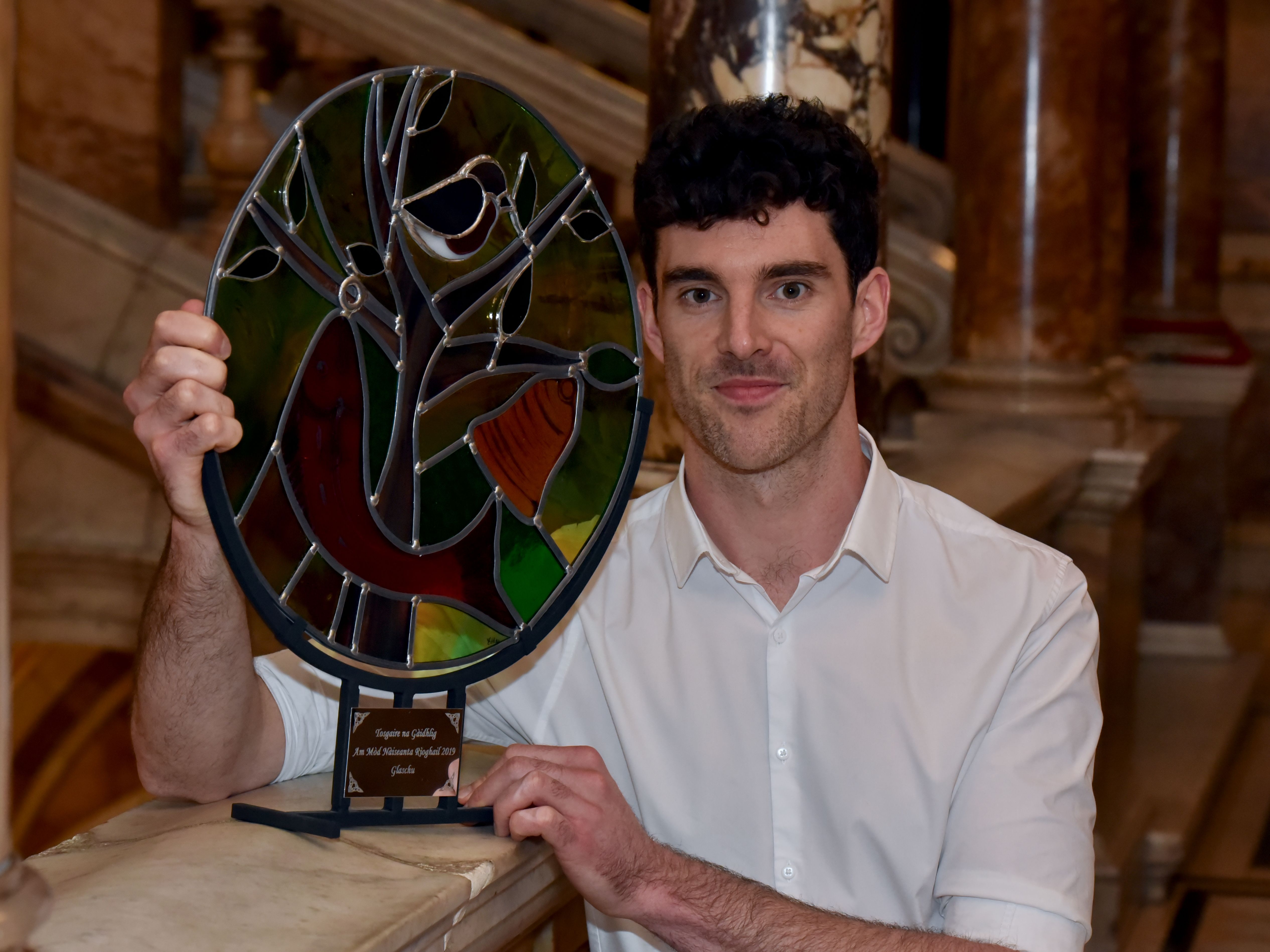
Alasdair Whyte was named as Gaelic Ambassador of the Year at the Royal National Mod in Glasgow in 2019, where he was presented with his award by Deputy First Minister, and Cabinet Education Secretary, John Swinney.

In 2008 the Scottish Government invited An Comunn Gàidhealach to nominate someone who, in view of their outstanding work for Gaelic, was worthy of recognition as Gaelic Ambassador of the Year. Government officials arranged the sourcing of an appropriate award from a local artisan in the Falkirk area, where the Royal National Mod was taking place that year, and the honour was presented to Gaelic singing star Julie Fowlis. An Comunn is delighted that the Scottish Government decided to continue awarding this annual honour, and that an award has been presented to the Gaelic Ambassador of the Year at each Royal National Mod since then.

As a result of the unique situation facing us this year we had to consider how best to proceed. Although Alasdair has done sterling work in supporting An Comunn since his personal award was presented to him, he has not been able to fulfil everything he had planned and we are extremely pleased to announce that we have now agreed with Alasdair that he will continue his role as Gaelic Ambassador until October 2021.

An Comunn President, Allan Campbell said, “We are delighted that Alasdair is willing to continue in his role and with his responsibilities as Gaelic Ambassador with us for another year, and we very much look forward to seeing all that he plans to achieve over the coming year.”


Read more »

Cymdeithas Calls on trustees not to close the House of Welsh (Tŷ'r Cymry) center in Caerdydd


Cymdeithas yr Iaith has called on the owners of Tŷ'r Cymry in Caerdyddnot to sell the house, following a decision by current members of the trustees' committee to close the Welsh language center and sell the building. The house was donated by Mr Lewis Williams "to the Welsh of Cardiff" in 1936, and has been a major center of the language's history in the capital for over eighty years. Tenants of the building have moved out after being ordered to do so - which includes Cymdeithas yr Iaith, UCAC, Plaid Cymru and Tŷ'r Cymry cylch meithrin, the first cylch meithrin to be established in Cardiff.

Bethan Ruth, the national chair of Cymdeithas yr Iaith, said: “The revival of the language in Cardiff has an important history for Tŷ'r Cymry, and there is no reason for that to end. We understand that maintaining a building like this is a pressure on a small crew that hasn't changed for a long time. But selling the building and closing the Welsh language center is not the answer - we are calling on the owners to pass the responsibility on to a new group that could re-establish the place as a modern Welsh language center on for 21st Century Cardiff.

Read more »