

CELTIC LANGUAGES NEWS

Most Read
-
 Stumdi organized an employment forum in Breton language (Forom an implic e brezhoneg) on Wednesday, March 21st, 2018 at the Le Family cult...
 -
 We have available each of the Celtic flags in 60 x 90 size as well as other sizes. Please write to: nsestat@gmail.com Ireland/Eire ...
 -
 Thousands of people have attended a march and street festival in Baile Átha Cliath (Dublin) to celebrate the Irish language on April 14th....
 -
 Students and An Dream Dearg movement protested outside Queens University in Béal Feirste / Belfast demanding respect and equal...
 -
Link to An Comunn Gàidhealach Newsletter (Gearran 2018)
-
 A GWYNEDD MP is to call for the Welsh language to be protected under equality legislation in a debate this afternoon. Liz Saville Robert...
 -
On 8 April 2021, the French National Assembly has witnessed a small revolution with the adoption, against the government’s opinion, of a l...
-
 The French education services recently refused to open a bilingual education class at the René-Guy Cadou public school in Kastell-Briant/...
 -
There will be four Gaelic events at the Aye Write festival in Glasgow in March. Tickets are available from www.ayewrite.com Eadar Pinn i...
-
 No Cornish language TV station broadcasting on a regular basis exists as of today, and this is what the Cornish Language Fellowship , or Ko...
2018/12/13
Ai'ta! denounces the installation of non-bilingual road signs
2018/12/12
QUBSU referendum votes in favour of a new Irish-Language Officer
Total Votes: 1488
Ar son • In favour: 1137 (76.44%)
In éadan • Against: 334 (22.46%)
Abstentions: 16 (1.10%)
Belfast Queen’s University students voted in favour of Irish Language and Trans officers in a campus-wide referendum. The referendum results are a welcome step forward in recognising the role that Irish speakers and Trans citizens play in our society and on university campuses.
Irish speaking students are entitled to the same rights as enjoyed by citizens who live their daily lives through the medium of English and this is a progressive move by QUBSU.

Ar son • In favour: 1137 (76.44%)
In éadan • Against: 334 (22.46%)
Abstentions: 16 (1.10%)
Belfast Queen’s University students voted in favour of Irish Language and Trans officers in a campus-wide referendum. The referendum results are a welcome step forward in recognising the role that Irish speakers and Trans citizens play in our society and on university campuses.
Irish speaking students are entitled to the same rights as enjoyed by citizens who live their daily lives through the medium of English and this is a progressive move by QUBSU.

2018/12/11
‘Gwenwyn’ by the band Alffa is the first Welsh language song to hit one million plays on Spotify

The band said the milestone was "nuts", with their song being streamed from Brazil to Australia.
"We weren't expecting anything like this," said guitarist and lead singer Dion Jones.
Jones and drummer Sion Land only finished
school in the summer, where they were sixth-form students at Ysgol
Brynrefail in Llanrug, near Caernarfon.As part of the Horizons project, which is
a collaboration with Arts Council of Wales, they have had the chance to
play summer festivals and showcase events, as well as being signed to
Welsh label Recordiau Côsh.
The label's founder, Welsh
singer-songwriter Yws Gwynedd, said Alffa's success had shown that
"language barriers are being blown wide open".
2018/12/10
€3 million being allocated for the Investment Plan for the Irish Language and the Gaeltacht
Although Conradh na Gaeilge welcomes the additional funding being made available in this year’s Budget, with approximately €3 million being allocated to some aspects of the Investment Plan for the Irish Language and the Gaeltacht agreed by 90 Irish language and Gaeltacht groups, this increase does not provide fairness for the Irish language and Gaeltacht communities.
It is positive that there will be additional capital funding for Údarás na Gaeltachta and other Irish language schemes - including Irish language centres, language planning schemes, Gaeltacht scholarships for children in DEIS schools, and grants for the Comharchumainn Phobal Ghaeltachta. And aside from the items included in the agreed Investment Plan, it is also positive that €1.5m is to be spent on travel infrastructure on Tóraigh and Árann. This additional promised funding, however, is not enough and there are many aspects of the Investment Plan which have not been granted any funding.
Dr. Niall Comer, Uachtarán an Chonartha, says that “Conradh na Gaeilge are disappointed that Taoiseach, Leo Varadkar, TD, has not done more, especially since we met him in June and discussed the devastating cuts made to Irish language and Gaeltacht funding since 2008, which have not been reversed by the Government in the past four years.”
“The €9m requested for the Investment Plan was needed in this Budget, in order to demonstrate fairness and support for Irish language and Gaeltacht communities.”
Conradh na Gaeilge recognise the increase in budget being made available, but there is a crisis in Gaeltacht areas at the moment, with essential services being reduced. It is high time that the Government accept responsibility and provide full, proper support and rights in order to protect these communities.
According to Julian de Spáinn, Ard-Rúnaí Chonradh na Gaeilge, “this budget demonstrates the need, more than ever, for a Senior Minister for the Irish language and the Gaeltacht within the Government. The preparative work has been done and a coherent way forward is included in the Investment Plan for the Irish Language and the Gaeltacht agreed by 90 Irish language and Gaeltacht groups – all the Government have to do is fund it. A majority of TD’s agree that this plan should be funded.”
Conradh na Gaeilge are appealing to the Taoiseach Leo Varadkar, TD, to rectify the lack of fairness in the budget for the Irish language and Gaeltacht communities, by supporting the Investment plan in its entirety in the revised Budget estimates, providing investment which would create over 1,150 jobs and create many other opportunities for the Irish language and its communities.”
It is positive that there will be additional capital funding for Údarás na Gaeltachta and other Irish language schemes - including Irish language centres, language planning schemes, Gaeltacht scholarships for children in DEIS schools, and grants for the Comharchumainn Phobal Ghaeltachta. And aside from the items included in the agreed Investment Plan, it is also positive that €1.5m is to be spent on travel infrastructure on Tóraigh and Árann. This additional promised funding, however, is not enough and there are many aspects of the Investment Plan which have not been granted any funding.
Dr. Niall Comer, Uachtarán an Chonartha, says that “Conradh na Gaeilge are disappointed that Taoiseach, Leo Varadkar, TD, has not done more, especially since we met him in June and discussed the devastating cuts made to Irish language and Gaeltacht funding since 2008, which have not been reversed by the Government in the past four years.”
“The €9m requested for the Investment Plan was needed in this Budget, in order to demonstrate fairness and support for Irish language and Gaeltacht communities.”
Conradh na Gaeilge recognise the increase in budget being made available, but there is a crisis in Gaeltacht areas at the moment, with essential services being reduced. It is high time that the Government accept responsibility and provide full, proper support and rights in order to protect these communities.
According to Julian de Spáinn, Ard-Rúnaí Chonradh na Gaeilge, “this budget demonstrates the need, more than ever, for a Senior Minister for the Irish language and the Gaeltacht within the Government. The preparative work has been done and a coherent way forward is included in the Investment Plan for the Irish Language and the Gaeltacht agreed by 90 Irish language and Gaeltacht groups – all the Government have to do is fund it. A majority of TD’s agree that this plan should be funded.”
Conradh na Gaeilge are appealing to the Taoiseach Leo Varadkar, TD, to rectify the lack of fairness in the budget for the Irish language and Gaeltacht communities, by supporting the Investment plan in its entirety in the revised Budget estimates, providing investment which would create over 1,150 jobs and create many other opportunities for the Irish language and its communities.”
2018/12/09
Young Scottish Gaelic speakers relatively stable
The report 'Young People and the Highlands and Islands: Maximising Opportunities' presents the findings of a wide-ranging study focused on the changing attitudes and aspirations of young people aged 15-30 in relation to the Highlands and Islands of Scotland. The study builds on previous research undertaken in 2015, exploring how opportunities around education, training and employment can be maximised for all young people. A total of 3,130 young people from within and outwith the region contributed to the research, sharing their views on the Highlands and Islands as a place to live, work and study.
The majority (68%) of participants did not have any Gaelic language skills. Just under one fifth (18%) had a little Gaelic, 6% said they had some Gaelic and 7% were fluent in Gaelic: 32 % in all. The launch of e-Sgoil in August 2016 has been an important development for educational
provision in the Outer Hebrides. e-Sgoil uses video technology to allow teachers to deliver classes from their homes, schools or e-Sgoil hubs to schools that are unable to employ staff within a particular subject. It was introduced to improve equity of subject choice in the Outer Hebrides but has been used to provide classes, particularly in Gaelic, to schools across Scotland. More encouraging picture than answers to binary yes/no census question showing 8% could speak, read or write Gaelic in 2011. Same survey in 2015 produced similar data Gaelic skills among young people in the islands: 8% fluent, 7% some Gaelic, 17% a little Gaelic: 33 % in all.
The majority (68%) of participants did not have any Gaelic language skills. Just under one fifth (18%) had a little Gaelic, 6% said they had some Gaelic and 7% were fluent in Gaelic: 32 % in all. The launch of e-Sgoil in August 2016 has been an important development for educational
provision in the Outer Hebrides. e-Sgoil uses video technology to allow teachers to deliver classes from their homes, schools or e-Sgoil hubs to schools that are unable to employ staff within a particular subject. It was introduced to improve equity of subject choice in the Outer Hebrides but has been used to provide classes, particularly in Gaelic, to schools across Scotland. More encouraging picture than answers to binary yes/no census question showing 8% could speak, read or write Gaelic in 2011. Same survey in 2015 produced similar data Gaelic skills among young people in the islands: 8% fluent, 7% some Gaelic, 17% a little Gaelic: 33 % in all.
2018/12/06
Cymdeithas yr Iaith welcome appointment of new Welsh language commissioner Aled Roberts
Osian Rhys, Chair of Cymdeithas yr Iaith said that they congratulated Aled Roberts on his appointment to the “vital” role.
” The Commissioner model has shown its value internationally as a way of protecting other languages, and is succeeding in Wales in various sectors, including the Childrens’ and Older People’s Commissioners,” he said.
“The Government’s plans in their White Paper to abolish the role make no sense, and have been rejected in a public consultation.
“There’s no sense in turning the clock back to an old, failed model that didn’t defend people’s language rights.
“The first thing the new Commissioner needs to do is work with the Government to ensure that the powers in the current Measure are used to the full.
“The Standards system, under the stewardship of the Commissioner, has started to make a real difference on the ground.
“The Commissioner needs to ensure that he and the Government use all the powers they have to implement the current law fully, including extending the Standards to train, bus, water, phone, broadband and energy companies.
“The existence of the Commissioner as a single champion for Welsh means it’s clear who we need to turn to in order to defend our language rights.
“Aled Roberts needs to be a fearless advocate for the language, who will protect its independence from the Government.”

” The Commissioner model has shown its value internationally as a way of protecting other languages, and is succeeding in Wales in various sectors, including the Childrens’ and Older People’s Commissioners,” he said.
“The Government’s plans in their White Paper to abolish the role make no sense, and have been rejected in a public consultation.
“There’s no sense in turning the clock back to an old, failed model that didn’t defend people’s language rights.
“The first thing the new Commissioner needs to do is work with the Government to ensure that the powers in the current Measure are used to the full.
“The Standards system, under the stewardship of the Commissioner, has started to make a real difference on the ground.
“The Commissioner needs to ensure that he and the Government use all the powers they have to implement the current law fully, including extending the Standards to train, bus, water, phone, broadband and energy companies.
“The existence of the Commissioner as a single champion for Welsh means it’s clear who we need to turn to in order to defend our language rights.
“Aled Roberts needs to be a fearless advocate for the language, who will protect its independence from the Government.”

2018/12/05
The Cooish 2018: Helping people to learn to speak Manx

On November 17th and 18th
the Cooish, a festival to celebrate and promote the Manx language, took place, and featured a variety of public events and workshops designed to
help people use Manx Gaelic in every day life. Adrian Cain, the Manx
Language officer from Culture Vannin, helped to organise the festival.
The last couple of
weeks have seen a series of language events arranged by Jeebin, The Manx
Language Network, to support speakers of the language.
The events are known as the Cooish, a Manx term that has a wide range of meanings, including a cause, chat or affair. The annual Ned Maddrell Lecture saw the start of the activities and this year’s presentation was delivered by T J O Ceallaigh of Limerick University.
He provided a brilliant overview of the present state of immersion education through Irish and an enthusiastic and large audience, given the torrential rain that day, went home inspired.
It’s hoped that Jeebin can now develop a close working relationship with Limerick University that allows a sharing of ideas and best practice between that institution and the Department of Education, Bunscoill Ghaelgagh and Culture Vannin here.
Last weekend saw a series of events which included a fantastic evening of music, a performance from the new Manx Bard, Annie Kissack, a lecture about the Tourist Industry from Nicola Tooms of Manx National Heritage and a pop-up Gaeltagh in the Café in Marks and Spencer.
It was very rewarding to see so many Manx speakers from a wide-range of backgrounds and ages enjoying using the language in such an informal setting and it demonstrates what a positive future the language has.
The last couple of weeks has also seen fluent and new speakers adopting Manx words from Archibald Cregeen’s Dictionary of the 1830s.
Every day this year Culture Vannin has been posting on Facebook and Twitter a word from his dictionary and during the Cooish we have been encouraging people to adopt, love and cherish a word and in doing so make the link between the world of Archibald Cregeen and the Manx of today.
This has proved to be a fun and light hearted way to engage people and anyone is welcome to adopt a word from the lexicon here, found at learnmanx.com
Contact adrian@culturevannin.im and we’ll get the word in the post to you.
The week also saw the presentation to Dollin Mercer from Manx Radio of the inaugural Londeyr Award given for his use and support for the language whilst the activities will continue this weekend with a Manx Gaelic beach clean.
Much has been achieved with Manx Gaelic over the last 20 years and the enthusiasm shown over the last few weeks demonstrates what an important community asset the language is.
More details are available from the Learn Manx Facebook page, or from learnmanx.com
by Adrian Cain
Language Development Officer
www.learnmanx.com
2018/12/04
Cymdeithas campaigners slap stickers on road signs in protest at lack of translation
According to Cymdeithas yr Iaith Gymraeg, there are hundreds of give
way signs in the county which are only written in English.
Over the weekend, the group chose to place stickers with the Welsh translation ‘Ildiwch’ on some of them in order to draw attention to the issue.
It comes as politicians prepare to discuss a damning report by the Welsh Language Commissioner this week, which highlights repeated problems with Welsh language signage in the area.
However, Wrexham Council has insisted it is not legally required to replace any give way signs which pre-date March 2016, when the Welsh Language Standards were introduced.
Aled Powell, who chairs the Wrexham branch of Cymdeithas, said: “Since before Wrexham Council was formed in 1996, there has been a legal duty on each authority in Wales to ensure road signs are in both Welsh and English.
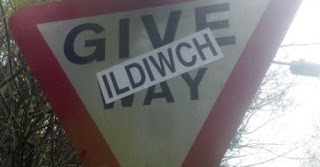
Over the weekend, the group chose to place stickers with the Welsh translation ‘Ildiwch’ on some of them in order to draw attention to the issue.
It comes as politicians prepare to discuss a damning report by the Welsh Language Commissioner this week, which highlights repeated problems with Welsh language signage in the area.
However, Wrexham Council has insisted it is not legally required to replace any give way signs which pre-date March 2016, when the Welsh Language Standards were introduced.
Aled Powell, who chairs the Wrexham branch of Cymdeithas, said: “Since before Wrexham Council was formed in 1996, there has been a legal duty on each authority in Wales to ensure road signs are in both Welsh and English.

2018/12/02
Kuzul ar Brezhoneg (Breton Language Council) new HQ
Kuzul ar Brezhoneg (Breton Language Council) opened new headquarters in Lannuon last November 29th. The Council is formed by 19 associations as Al Lanv, Al Liamm, Hor Yezh, KEAV or Skol Ober. They are centered in edition, education and interceltic links. The Council was formed in 1959.


2018/12/01
Council under fire over inaccurate Welsh language signs in Wrexham
The Welsh Language Commissioner launched an investigation into the
authority after receiving 14 complaints from members of the public.
They included concerns over signs which were only in English on the doors of the former People’s Market and Welsh text being displayed underneath English on a sign below a Christmas tree in Wrexham.
Meri Huws has now taken enforcement action to ensure that any text displayed on signs that are put up is shown correctly in Welsh.
She has also ordered the council to make certain that the Welsh wording is not treated less favourably than English.
In a report which found it had failed to comply with Welsh language standards, Ms Huws said: "The council has been under a duty to comply with these standards since 30 March 2016.
"I note that the mistakes referred to in complaints are often typos or highlight the lack of use of a circumflex accent on permanent signs.
"Whilst I acknowledge that mistakes can happen from time to time when dealing with text on a sign; it appears that where there are mistakes on Welsh versions, there are no mistakes on English versions.
"I acknowledge that the council has developed some guidance and has taken some steps to promote the requirements of the standards amongst staff.
"However, I am of the opinion that the steps taken have not been sufficient, in particular in the context of erecting signs to ensure full understanding of the impact of the standards and the culture change required in order to comply with them.
"It appears that English only signs and signs that treat the Welsh language less favourably that the English language continue to be erected by different departments of the council, and that this is happening when erecting both permanent and temporary signs."
Source
They included concerns over signs which were only in English on the doors of the former People’s Market and Welsh text being displayed underneath English on a sign below a Christmas tree in Wrexham.
Meri Huws has now taken enforcement action to ensure that any text displayed on signs that are put up is shown correctly in Welsh.
She has also ordered the council to make certain that the Welsh wording is not treated less favourably than English.
In a report which found it had failed to comply with Welsh language standards, Ms Huws said: "The council has been under a duty to comply with these standards since 30 March 2016.
"I note that the mistakes referred to in complaints are often typos or highlight the lack of use of a circumflex accent on permanent signs.
"Whilst I acknowledge that mistakes can happen from time to time when dealing with text on a sign; it appears that where there are mistakes on Welsh versions, there are no mistakes on English versions.
"I acknowledge that the council has developed some guidance and has taken some steps to promote the requirements of the standards amongst staff.
"However, I am of the opinion that the steps taken have not been sufficient, in particular in the context of erecting signs to ensure full understanding of the impact of the standards and the culture change required in order to comply with them.
"It appears that English only signs and signs that treat the Welsh language less favourably that the English language continue to be erected by different departments of the council, and that this is happening when erecting both permanent and temporary signs."
Source
FLAGS AVAILABLE

GAEILGE

CYMRU

TRURO

ROAZHON

KASTELL-BRIANT

BÉAL FEIRSTE

BÉAL FEIRSTE

BREIZH

AN RITH 2018

AR REDADEG 2018

BLIAN NA GAEILGE

AN RITH 2018

MOST READ
-
 The first ever television chat show in the Cornish language has been launched. Two pilot episodes of 'Jaqi ha Jerry' have been made...
 -
The town council paid a contractor by cheque but when he presented it to a branch of Lloyds Bank in England, it was refused .The contracto...
-
A report into Irish language pre-school education in Northern Ireland has been published almost three years after it was completed. The re...
-
Welsh will no longer be classed as a second language in English-medium schools, under new proposals. All pupils will follow the same curric...
-
The Irish Language Week 2019 is an annual event which runs from 1st – 17th March. The festival, the aim of which is to encourage communit...
-
 Deputy First Minister, John Swinney MSP officially opened Bun-sgoil Ghàidhlig Phort Rìgh in September. Support given to Highland Council by ...
 -
Fife Council has revealed that one in every 30 speakers of Scottish Gaelic are living in Fife. Kirsty Strachan, Gaelic Development Offic...
-
The International Celtic Congress 2019 will be held at the Hotel Bristol at Newquay. Thursday 25th. April - Tuesday 30th. April. The Int...
-
RTÉ has thrown the Irish language “on the scrapheap”, the watchdog to protect the language has claimed. An Coimisinéir Teanga Rónán Ó D...
-
45 schools in Galway are to benefit from almost 1.5 million euro in funding under the Irish Language Assistants Scheme. The new funding com...