2021/05/03

Scottish National Party announce plans to explore creation of a Gàidhealtachd, a recognised Gaelic-speaking area

THE SNP has announced plans to secure the future of Gaelic by investing in education and exploring the creation of a recognised Gaelic-speaking area. 

The party said it will work to ensure Gaelic flourishes throughout Scotland as well as in its traditional heartlands if it is re-elected in May.

It also said it would "review the functions and structures" of Bòrd na Gàidhlig (BnG), the quango responsible for promoting the language. 

BnG has been the focus of criticism over its performance. 

The SNP said it would look into creating a recognised "Gàidhealtachd" to raise levels of language competence and encourage the provision of more services in Gaelic.

The Gaidhealtachd is the area of Scotland where people speak Gaelic and usually refers to the Highlands and islands. 

In Ireland, Irish-speaking areas have official recognition as Gaeltacht regions.

Some campaigners have called for consideration of Gaelic-speaking housing developments in Scotland, pointing to similar schemes in Ireland.

SNP Finance Secretary Kate Forbes previously told The Herald she would be supportive of this. 

Elsewhere, the SNP said it will encourage the creation of new stand-alone Gaelic medium primary and secondary schools across Scotland, backed by investment to increase the number of teachers who can teach in Gaelic. 

It comes amid warnings Gaelic is in crisis.

Alasdair Allan, the SNP's candidate for the Western Isles, said the party "fully recognises the massively important contribution the Gaelic tradition has and continues to make to Scotland’s rich culture". 

He said: "This commitment will be welcomed by both Gaelic and non-Gaelic speaking Scots alike and will be key to encouraging the use of Gaelic in our communities.

"We will put our money where our mouth is to encourage the creation of new Gaelic primary and secondary schools across the country with major investment to increase the number of teachers who can teach through Gaelic.

"We want to increase the range of subjects that can be taught in GME for both a broad general education and in the senior phase of secondary school. 

"That’s why we will explore the bursaries that are available to encourage conversion to Gaelic.

"The pandemic has highlighted the importance and value of e-Sgoil and Stòrlann in making Gaelic education resources available. 

"We will ensure they continue to be supported in order to help in school education, adult learning, teacher support and community learning.

"We believe there is value is creating a recognised ‘Gàidhealtachd’ to raise levels of language competence and the provision of more services through Gaelic.

"Supporting the creation of a Gàidhealtachd helps reinforce what is the position in some parts of the country already. A recognition of Gaelic as a primary language of a place.

"Through reviewing the functions and structures of Bòrd na Gàidhlig, we will explore how it can support the formal recognition of a Gàidhealtachd. 

"The review will also consider how the Scottish Government and BnG can work with other bodies that have functions in arts, tourism and heritage to explore what more they can do to help deliver faster rates of progress for Gaelic.

"In order to achieve these ambitions, we will ensure that Sabhal Mòr Ostaig’s place as a centre of excellence for provision of Gaelic training is both recognised and supported, with dedicated funding to offer FE/HE courses through and for Gaelic.

"And in the next parliament we will also bring forward a new Scottish Languages Bill which takes further steps to support Gaelic, act on the Scots language and recognises that Scotland is a multilingual society.”

Read more »

2021/02/08

Bòrd na Gàidhlig chief: There is 'real anguish' about situation facing Gaelic

 WITH warnings it could die out as a community language within a decade, the precarious position of Gaelic in Scotland has come under the spotlight in recent months. Shona MacLennan, chief executive of Bòrd na Gàidhlig, the quango responsible for promoting the language, is among those entrusted with making sure it has a future.


Read more »

Five village signs to be replaced with Gaelic translation in South Ayrshire


Five village welcome signs are to be translated into Scots Gaelic in South Ayrshire. The new signs will go up in Barr, Barrhill, Colmonell, Pinmore and Pinwherry. They are currently being manufactured and are due to be erected in upcoming weeks by the Ayrshire Roads Alliance. The boards will also retain the English place name as well.

And the move is part of efforts being made to promote the language in the area in line with South Ayrshire Council’s Gaelic language plan.

However, Councillor Philip Saxton said: “I don’t think public money should be used for this. There are more important things.”

The Labour councillor pointed out the measures are being put in place under Scottish Government guidelines.

Gaelic email signatures were rolled out for council staff in December with the hope that more employees will take an interest in learning the tongue.

One employee uses a few phrases on emails currently while a progress report on the Gaelic language plan is being sent to Bòrd na Gàidhlig.

It was signed off by SNP and Labour councillors sitting on the leadership panel earlier this week.

Read more »

2020/12/11

Duaisean Gàidhlig na h-Alba 2020

Thèid na Duaisean a chumail air Dimàirt 15 Dùbhlachd le cuirm bhiortail air a stiùireadh le bean an taighe, Cathy NicDhòmhnaill.

The Awards will take place on Tuesday 15th December with a virtual ceremony hosted by Cathy
MacDonald. 

https://www.scottishgaelicawards.co.uk/gaelic/

Read more »

2020/11/02

Celtic Charter : housing market pressures and public policy is putting Celtic languages at stake

The rural housing crisis is threatening our future, claim activists from Scotland, Ireland, Wales, Isle of Man and Cornwall who have united in a cross-border plea over the survival of Celtic languages.

In an appeal aimed at authorities in each of those countries and territories, culture groups say housing market pressures and public policy is putting their languages at stake. These include Scots Gaelic, Irish, Welsh, Manx and Cornish.

They’ve drawn up a Celtic Charter that asserts a “right to a home” for speakers of these languages in their geographical heartlands. However, they say high costs and the proliferation of holiday lets in rural areas means the tongues themselves may soon be driven from those areas.

The charter – or Cairt taigheadais Cheilteach in Gaelic and Siarter Tai Celtaidd in Welsh – is a collaboration between groups including Scotland’s Misneachd, its Irish equivalent Misneach and Cymdeithas of Wales. It includes contributions in Cornish from Mebyon Kernow.

It includes 11 different demands, including the introduction of a “punitive tax” on homes used for Airbnb lets, a statutory cap on the proportion of second or holiday homes within communities, rent management to match local earnings and “specific supports for minority language speakers to remain in their communities”.

“This issue has never been more important to the survival of Gaelic communities,” Skye architect Martainn Mac A’Bhaillidh of Misneachd told the Sunday National.“I know loads of families working at Sabhal Mòr Ostaig and in the Western Isles who are raising Gaelic-speaking kids with little to no hope that they will be able to live in the community they grew up in. It’s a completely unsustainable situation.”

That research was published by the University of the Highlands and Islands in July and found Scots Gaelic was “at the point of collapse”, with vernacular Gaelic likely to die out within only a decade as a result of the factors including the “social and economic modernisation” of the islands and the arrival of “new social players” who do not have the language amongst the biggest issues.

According to the Charter, these are issues that cross Celtic regions. It states: “We as organisations representing the minority languages of the Celtic nations, declare that urgent action must be taken. The damage done to our languages ​​and their communities must be undone – including in some areas where our languages ​​are no longer spoken.

“Homelessness is increasing, with more and more people unable to afford to live in their native areas. We regret that this is a result of the policies of the devolved and central governments. They include austerity and decades of economic inequality that disadvantage our rural communities.

“We therefore call on our governments to adopt a series of policies to ensure that the people who live and work here ... can afford to stay in their communities.”

Bethan Roberts of Cymdeithas says it’s already making a difference where she is. “Our ideas from the housing charter have resonated with people in Wales,” she said.

“Some progressive parties have already stated that they will be implementing some of the policies into their manifestos for next year’s Welsh Senedd election.

“We were very inspired working across different language communities. In an increasingly connected society, it’s easier than ever to create these links and learn from each other and work together. We face similar challenges and believe that our voices can be strengthened by coming together.”

Mac A’Bhaillidh hopes the same will happen here, but he says chances have already been missed, such as the Airbnb restrictions proposed by Scottish Greens MSP Andy Wightman


These failed to garner the backing of SNP and Tory members of the Scottish Parliament and, in an open letter released earlier this week, signatories including crofters and development officers claimed 40% of housing stock on both Tiree in the Inner Hebrides and West Harris in the Western Isles are holiday homes.

And while the provision of Gaelic-medium education has increased across the country, Mac A’Bhaillidh has little sympathy for the idea that indigenous speakers take their language with them when they move to areas where they are not spoken.

“Languages don’t survive without community around them,” he says. “They just don’t.

“There is very little evidence of languages surviving more than one or two generations in that context.

“There were 100,000 Irish-speaking people in Glasgow, where are they now?” he asks. “Millions of Irish speakers went to New York, where are they today?

“Whenever this housing issue is brought up there is a lot of hand-wringing – ‘what can we do?’

“In the Lake District, in the Channel Islands, in Cornwall and Norway and New Zealand we see action being taken to limit and set rules about who can buy a house where. It’s not that it can’t be done, it’s that there isn’t the will.”

A Scottish Government spokesperson said: “We recognise the importance of housing in areas of indigenous languages and the role that housing partnerships have in supporting these communities.  

“The Scottish Government is willing to work with all parties to support all communities.”


The Celtic Charter for Housing – a Right to a Home is given below. A
excellent multilingual video (English subtitles) accompanying it is available on the Cymdeithas yr Iaith website and versions in Irish, Gaidhlig, Welsh, Manx and Cornish languages – click here  https://cymdeithas.cymru/siartertai

Celtic Housing Charter – the Right to a Home


The rural housing crisis is a huge problem that threatens the future of Celtic language-speaking communities.


We as organizations representing the minority languages of the Celtic nations, declare that urgent action must be taken. The damage done to our languages ​​and their communities must be undone- including in some areas where our languages ​​are no longer spoken.


Homelessness is increasing, with more and more people unable to afford to live in their native areas. We regret that this is a result of the policies of the
devolved and central governments. They include austerity and decades of
economic inequality that disadvantage our rural communities. We therefore call on our governments to adopt a series of policies to ensure that the people who live and work here including those belonging to marginalized and minority communities can afford to stay in their communities. This would be for the benefit of our languages ​​and the prosperity of our communities, with due regard to equality of opportunity regardless of class, race or gender. Those measures should include:


 cap the percentage of second or holiday homes within a community
 changing the definition of affordable housing and managing rent prices so that they are affordable to people on local wages
 further regulating and introducing a punitive tax on the use of houses
primarily or exclusively for AirBnB, including defining the use of houses or
flats as a whole as second homes or AirBnB
 develop a strategic plan for housing and tourism in rural areas to counter the fact that many houses have been taken out of the locally available housing stock
 devolve planning powers, including setting housing targets, to the most
appropriate local level, and require that language planning is mandatory;
 close any weaknesses or loopholes in the law that allow taxes to be avoided

 property legislation to control prices, specific supports for minority
language speakers to remain in their communities and to ensure the use of
empty and existing housing before new development is undertaken
 return social housing stock to public ownership, return underused stock to public ownership, and all ‘new builds’ to include a major element of public ownership
 a tax on landlords’ profits to invest in bringing empty and second homes
back into use for communities and those who live and work in them
 incentives to renovate and / or build sustainable housing in terms of
material and method of construction
 penalties for refusal to let property to members of disadvantaged
communities such as travellers or refugees.

Read more »

2020/10/23

Alasdair Whyte to continue as Gaelic Ambassador until 2021

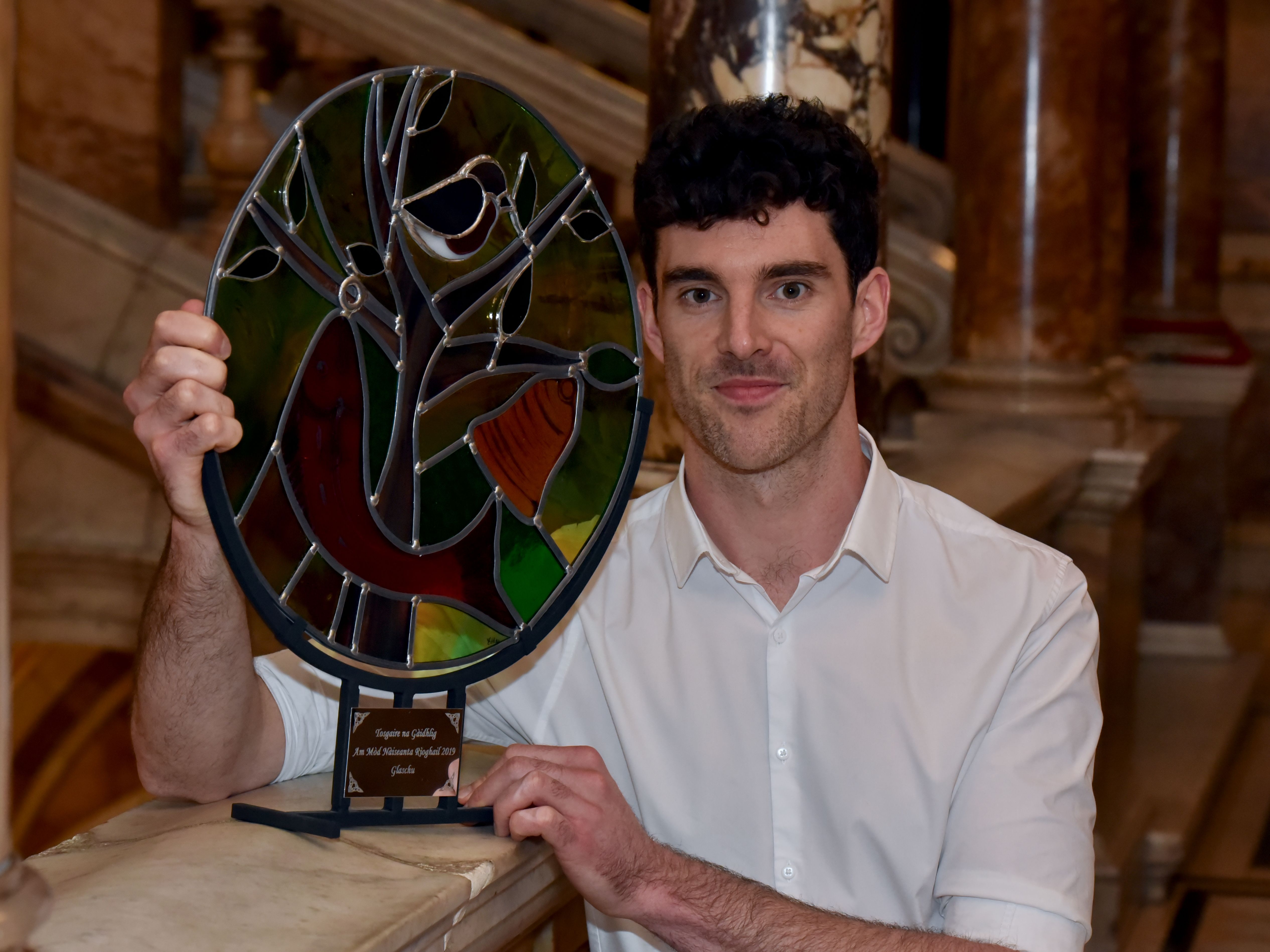
Alasdair Whyte was named as Gaelic Ambassador of the Year at the Royal National Mod in Glasgow in 2019, where he was presented with his award by Deputy First Minister, and Cabinet Education Secretary, John Swinney.

In 2008 the Scottish Government invited An Comunn Gàidhealach to nominate someone who, in view of their outstanding work for Gaelic, was worthy of recognition as Gaelic Ambassador of the Year. Government officials arranged the sourcing of an appropriate award from a local artisan in the Falkirk area, where the Royal National Mod was taking place that year, and the honour was presented to Gaelic singing star Julie Fowlis. An Comunn is delighted that the Scottish Government decided to continue awarding this annual honour, and that an award has been presented to the Gaelic Ambassador of the Year at each Royal National Mod since then.

As a result of the unique situation facing us this year we had to consider how best to proceed. Although Alasdair has done sterling work in supporting An Comunn since his personal award was presented to him, he has not been able to fulfil everything he had planned and we are extremely pleased to announce that we have now agreed with Alasdair that he will continue his role as Gaelic Ambassador until October 2021.

An Comunn President, Allan Campbell said, “We are delighted that Alasdair is willing to continue in his role and with his responsibilities as Gaelic Ambassador with us for another year, and we very much look forward to seeing all that he plans to achieve over the coming year.”


Read more »

2020/10/22

Comann nam Pàrant Coinneamh Bhliadhnail/AGM

On the 19th June Comann nam Pàrant hold its Annual General Meeting over Zoom. "Holding a Zoom meeting was a first for us, but we are very pleased that it worked well. We had over 14 in attendance with representatives from across the country. We are very pleased that our 3 officer bearers, Helen MacKinnon from Glasgow as Chair, Fiona Stephens from Edinburgh as Vice Chair and Gill Steele
from Aberfeldy as Secretary, are willing to remain in their roles for another year. Marsaili Dow also continues in her role as treasurer. We would like to thank them and the rest of the committee for their continued hard work in representing the Gaelic Medium parents’ voice across the country. We were also delighted to welcome Emma Burrows from Portree to the committee, great to have a representative from the Isle of Skye. With the ongoing threat of COVID-19 we plan to continue utilising Zoom as our meeting platform which should also make it easier for members to attend meetings.
Edinburgh Gaelic week for schools Due to COVID-19 we had to cancel our Gaelic School’s week in Edinburgh at the end of April. We had almost 400 pupils registered this year, and we were looking
forward to seeing them. We have worked with Our Dynamic Earth, one of the venues that we visit every year, to produce online Gaelic resources for schools.
There are now eight worksheets translated into Gaelic which have bee sent round schools. Topics include,Rainforests, Fish, Antarctica and Clouds. We hope that these resources are useful for teachers and have given pupils the opportunity to receive exciting resources in Gaelic. If there is any teacher or school who hasn’t received these and would like a copy, then please contact – innes@cnag.org

Read more »

2020/07/30

Misneachd want speakers of the language protected under hate crime legislation

Pressure group Misneachd has submitted a response to the Hate Crime and Public Order (Scotland) Bill calling for the term ‘minority language’ to be adopted to protect all linguistic minorities from language-based hate.
It says the Scottish and UK Governments should consult on having linguistic minorities seen alongside race, religion, disability, sexual orientation and transgender identity for legal protection.
The same would apply to speakers of Scots, British Sign Language and immigrant community languages, as well as indigenous minority languages of other parts of the UK such as Welsh, Irish and Cornish.
The Bill is a response to the recommendations made in Lord Bracadale’s independent review of hate crime laws.
Lord Bracadale had said some consultation responses referred to discrimination and prejudice against Gaelic speakers.
While attitudes had improved, they noted there were fairly common examples in social media and in mainstream print media of hostility to the language and its speakers.
It was suggested mockery and criticism of the Gaelic language were not taken as seriously as equivalent statements towards other protected groups would be, including about public spending decisions.
Lord Bracadale said the evidence put forward highlights some “deeply unpleasant behaviour” but would not generally appear to reach the threshold of criminal behaviour.
But he said there is a fairly strong argument that Gaelic speaking Gaels belong to an ‘ethnic group’ within the meaning of the current race aggravation, and where hostility towards Gaelic speakers amounted to a criminal offence, prosecution should be considered.
Misneachd spokesman Màrtainn Mac a’ Bhàillidh said: “Our proposal to make language a protected characteristic would be in line with the UK and Scotland’s international human rights commitments, and would cover Gaelic, Scots and British Sign Language as well as immigrant community languages.
“With respect to Gaelic, it would give a clearer protection than Lord Bracadale’s “fairly strong argument” that Gaelic speakers constitute an ‘ethnic group’, which is yet to be tested in court, and has been complex to prove with respect to other groups.
“It would protect all speakers of Gaelic and other minority languages, including second-language speakers, regardless of whether they consider themselves as belonging to a particular ethnic group.
“It would also send out a clear statement against widespread ignorance about language issues and multilingualism in our diverse society, and would offer protection in cases where the accused has, for example, objected aggressively to the use of the language but without referring to the race or ethnicity of the speakers.”

Read more »

2020/05/14

Duolingo's Scottish Gaelic course a right old barnstorming success: 300,000 people are signed up to the smartphone module

Duolingo's launch of a Scottish Gaelic learning course would appear to have been a right old barnstorming success, as it says around 300,000 people are currently signed up to the smartphone language module.

Oddly enough it's not Scots powering the Gaelic wave, as stats from the language app show that more users on the course are based in the US (35 per cent) than the UK (34 per cent). The 300,000 number marks quite a roaring interest, as the most recent census data showed 57,375 Scots claiming to be able to speak Gaelic, so having 300k more rock up with their brave attempts at pronunciation is a massive surge of interest.

Colin Watkins from Duolingo says the app will be updating soon with more Gaelic content, for your mind-expanding lockdown thrills and future interactions with the elderly locals when and if holidaying in the more rural bits of Scotland.

Read more »

2020/01/26

Bòrd na Gàidhlig deemed a “total disaster” by SNP MSP

People in the Gaelic community ought to feel let down by the failings of the organisation set up to promote the language, a committee of MSPs said last week.

The MSPs have been probing the work of Bòrd na Gàidhlig in the wake of a highly-critical report from public-sector watchdog Audit Scotland.

Caroline Gardner, the Auditor General for Scotland, said a “culture of mistrust” had built up within the Bòrd, which had suffered from ineffective leadership and a lack of transparency in decision-making.

Under questioning from MSPs on the public audit and post-legislative scrutiny committee last Thursday, the auditor general and the consultants who had carried out the recent report suggested external help would be needed to resolve the agency’s problems.

The SNP’s Alex Neil was damning in his criticism after being told that recommendations made six months ago were still under consideration.

He said: “The work they are supposed to be doing is vital for the linguistic and cultural future of the country. And they are badly letting down people. If they can’t get their act together they should go. Both the senior management team and the board – they are getting paid well enough.”

The Bòrd’s chief executive Shona MacLennan is paid a salary of £90,000 a year, while senior management posts at the Inverness-based organisation command annual salaries of between £65,000 and £85,000.

Mr Neil suggested the management team was ‘top heavy’ for an organisation with an annual turnover of £5 million.

“A second-tier manager could run this on their tea break,” Mr. Neill added. “It’s a small organisation, and yet it seems to be a total disaster.

“It seems to me they (senior management) are not justifying the level of salary they are on.

“The board isn’t providing any effective leadership. The question is, why are they still there?”

Mr Neil was told that the wider Gaelic speaking community hadn’t been consulted when the Bòrd’s latest improvement plan was drawn up.

“Is that not part of the problem? The main users – the people – weren’t consulted on it,” Mr Neill asked.

“Surely if you are drawing up a business plan, you have to consult the customers first.” Ms Gardner said that while she accepted that the Bòrd was a small organisation, she didn’t accept it was “necessarily a simple one”.

She added: “Gaelic has a very important place in Scottish life, but it’s fragile in terms of the numbers who use it routinely and the geographic location of these communities.”

The consultants acknowledged that the Bòrd had to work from a small talent pool.

The SNPs Colin Beattie and Tory Liam Kerr both called for the agency to drop its requirements for all employees and members to speak Gaelic, in a bid to attract greater expertise – notably in financial roles.

Labour’s Rhoda Grant supported the principle behind the all-Gaelic policy and said anyone involved with the Bòrd should at least be ‘vested’ in their support for the language, either as a speaker or someone committed to learning it.

The committee branded it as unacceptable that Bòrd na Gàidhlig were still holding official meetings in private.

Article


Read more »

2020/01/23

Western Isles council becomes first to teach every pupil in Gaelic

All primary one pupils in the Western Isles are to be automatically enrolled in Gaelic medium education (GME) from next year. Comhairle nan Eilean Siar – the council for the Western Isles – have adopted a policy of ‘Gaelic first’ to increase the rate of growth for Gaelic in the islands.
The 2011 census showed 52 per cent of the population of the Western Isles, aged three and over, spoke Gaelic.
Supporters welcomed the move, saying it is a reversal of the previous situation where English was the main language, unless parents asked for their children to be taught in Gaelic.
Primary and secondary headteachers and parent councils were informed of the policy in a letter last week from Bernard Chisholm, the council’s director of education.
Under the new policy, pupils will be taught in Gaelic and will start learning English from P4 onwards.
Parents have the option of opting out and having their children taught in English from P1.

Chisholm said the “Outer Hebrides is a Gaelic speaking community with a rich Gaelic heritage and culture” and the “majority of our children in nursery and those enrolling in primary, want to speak our language”.
He said being bilingual was beneficial to children’s academic development and would improve job opportunities.
“A significant number of families, who move to the area without Gaelic, enrol their children in GME for the additional benefits of bilingual education,” he said. “I believe that we all want our children to access the undoubted benefits that GME provides, in both English and Gaelic, in terms of reading, thinking skills, problem solving, maths and in many other areas.

Shona MacLennan, chief executive of Bòrdna Gàidhlig, the principal public body promoting Gaelic, said: “Comhairle nan Eilean Siar’s policy to have GME as the default choice for pupils entering primary one is a significant and welcome contribution.
“They, like many public bodies, have a Gaelic language programme.
“In its most recent plan there is a commitment to increase the number of pupils entering P1 Gaelic-medium education to 55 per cent by 2020 and the change to GME as the default choice will support this.”

Read more »

2019/12/04

Scottish Gaelic finally available on Duolingo, for free

It’s time to see Scotland in full colour. Scottish Gaelic is now available on Duolingo, for free. Download Duolingo for iOS or Android, or visit duolingo.com/enroll/gd/en/L
Learn something new in just 5 minutes a day and share with your friends

Read more »

2019/10/06

Welsh Language Society meeting in Ceredigion to highlight housing issue

Campaigners from Cornwall, Wales and Scotland will meet in Ceredigion next month to discuss tackling the house price crisis, with special attention given to how holiday homes threaten the Welsh language.
In Ceredigion, house prices are more than seven times average wages. Last year, 39% of the homes sold in nearby Gwynedd were either holiday homes or ‘buy to let’ – a rise of 34% from the previous year.


Following a campaign by Cymdeithas yr Iaith, councils were given the right to raise the level of council tax on second homes, and many of them have since increased the tax over the last two years.
In St Ives in Cornwall around a quarter of all homes are second homes. Following a referendum three years ago, a new rule was introduced that means no new homes can be bought as second homes.
Cllr Loveday Jenkin from Cornwall Council and architect Màrtainn Mac a'Bhàillidh from a language group in Scotland will be among the speakers at a discussion in Aberystwyth about housing organised by Cymdeithas yr Iaith.
It will be held in Canolfan y Morlan on Saturday, October 12 (2pm) and Robat Idris from Cymdeithas yr Iaith said: “More and more people are finding it difficult to live in their local area. In turn, that undermines community life, our towns and our villages and the Welsh language.
“We need a property system which ensures that house prices reflect what local people can afford. That’s why we’ve decided that housing, including holiday homes, will be the main focus of our annual general meeting.
“We hope to bring speakers together from various countries in order to discuss what we can do differently. Some policies in Porth Ia (St Ives) in Cornwall offer an answer to the problems, with restrictions on second homes.
“But we need to consider other measures in order to bring prices down. One possible answer is to normalise houses as a public service in public hands rather than a private asset. Bringing the right to buy to an end was a step in the right direction, but how do we bring the present private housing stock back into the hands of local communities?
“It also needs to be realised that unaffordable houses are only part of the reason for the patterns of out-migration and in-migration that are undermining the language in our communities.
“Our ‘Gwaith i Adfywio Iaith’ (Work to Renew a Language) policies which we published last year offer some simple measures to get to grips with the economic challenges, including recommending establishing local banks with the support of local councils and their pension funds; a tourism levy to support investment in broadband access in every part of the country; abolishing tuition fees for students who stay to study in Wales; devolving hundreds of jobs out of Cardiff; and establishing training colleges for health workers and vets in Aberystwyth and Bangor.”

Link to the event

Read more »

2019/09/06

New Bible translation released for Scots Gaelic speakers

New Bible resources have been produced for Scotland's Gaelic-speaking community, including an updated translation of the New Testament.
The translation project spanned 10 years and brought together representatives from the Church of Scotland, the Free Church of Scotland and the Roman Catholic Church.
New audio versions of the four Gospels in Gaelic are in the process of being recorded on the Isle of Skye, where there is a strong Gaelic-speaking tradition.
They are due to be released in autumn as part of the effort to support Gaelic speakers in their engagement with the Bible and their walk of faith.
Rev James Stuart, minister of Killin, was the first to translate the New Testament into Scottish Gaelic in 1767, just two decades after the battle of Culloden.
Until now, Gaelic speakers have relied on the 1801 edition that was produced by Rev Stuart's son, John, minister of Luss, by Loch Lomond.
The new translation replaces the old Gaelic from over two centuries ago with the modern Gaelic more commonly spoken today.
The resources are the work of the Scottish Bible Society, the Gaelic Books Council and the Church of Scotland's Gaelic Group.
There are around 54,000 Gaelic speakers in Scotland but there have been attempts by the Scottish Parliament to increase this number in recent years.
The Church of Scotland has echoed this effort by establishing the Gaelic Group and, more recently, employed a dedicated Gaelic development officer to oversee the work of its Gaelic Language Plan over the next year.
One aspect of the plan has been to survey the current use of Gaelic in the entire Church of Scotland and identify areas of potential growth for Gaelic-led ministry.


The new translations replace the old Gaelic of the 1801 edition with the modern Gaelic more commonly spoken today(Photo: Church of Scotland)
Work on the Bible translations was helped by funding from Bòrd na Gàidhlig, an internal Church of Scotland grant, and from Action of Churches Together in Scotland (ACTS).
Rev John Urquhart, a Church of Scotland minister in the translation team, said: "It has been a decade since the Scottish Bible Society brought the translation team together to begin the New Testament project.
"Though we were drawn from different places and different churches, we all shared the same aim: that the Scriptures of the New Testament should be made available to Gaelic speakers in modern Gaelic, faithfully translated.
"Throughout our work, we kept our focus on fidelity to the Greek and the clarity of the Gaelic.
"The translators hope that putting the word of God into contemporary Gaelic will enable every person who reads it to hear God's voice speaking to them, and that through this they will come to know the peace and salvation that are to be found only through Christ.
"Our desire is that all praise, and honour, and glory, be given to God and to God alone."
Elaine Duncan, Chief Executive of the Scottish Bible Society, praised the "gifted, committed and passionate" translators for their work on the project.
"Their faithfulness, love of the Bible and handling of the Greek and Gaelic languages have been essential to the success of this project," she said.
"We are thankful for the partnership and support of the Gaelic Books Council, and we pray that God's Word will be appreciated and understood more through providing the New Testament in the New Gaelic Translation."
Alison Lang, Director of the Gaelic Books Council, added: "It is appropriate that this new translation is being published in the UNESCO International Year of Indigenous Languages, and we hope that churches, schools and individual readers will enjoy this beautiful book."
The scholarship that has gone into the new translation was recognised in a motion put forward in the Scottish Parliament last month by Alasdair Allan, MSP for the Scottish National Party.
He said: "The Parliament warmly welcomes the new translation of the New Testament, and praises the huge amount of work that has been put into this by Rev John Urquhart, Rev Ruairidh MacLean, Rev John Lincoln and the late Canon John Angus MacDonald over the course of ten years.
"The Parliament also considers that this new publication represents one of the many ways in which the Gaelic world will be celebrating the International Year of Indigenous Languages in 2019."
The Gaelic NT New Translation is available to buy now online through the Scottish Bible Society and the Gaelic Books Council, or by calling 0141 337 6211.

Read more »

2019/03/28

Grants approved for Scottish and Irish Gaelic joint projects and for drama companies

At the second meeting of 2019 on Friday 8 March in Belfast,  the Foras na Gaeilge board approved grants for Scottish and Irish Gaelic joint projects and for drama companies throughout the island.
€32,522 worth of grants were approved under the Colmcille Grants Scheme, a scheme which fosters relations and strengthens the connection between the Scottish and Irish Gaelic language communities. The projects to be run during 2019 include Nasc with Sgoil an Taobh Siar, Isle of Lewis, which is being run by An Clár as Gaeilge (€12,000), Scottish Gaelic Programme for the Willie Clancy Summer Scheme 2019 (€4,500) and Òran Bagraidh with Cumann Cultúrtha Mhic Reachtain (£3,500).
€209,729 has been approved for 16 drama companies under the Drama Companies Scheme 2019 including Aisling Ghéar, Belfast (£24,000), Fibín, Galway (€27,360), High Rock Productions, Dublin (€19,000), Ababú, Belfast (£10,000) and Graffiti, Cork (€15,000).

Read more »

2019/03/05

Report reveals how many Gaelic speakers live in Fife

Fife Council has revealed that one in every 30 speakers of Scottish Gaelic are living in Fife. Kirsty Strachan, Gaelic Development Officer, brought forward a report to the council’s Community and Housing Services committee on Thursday, outlining the Gaelic Language Plan.

Under the 2005 Gaelic Language (Scotland) Act, all local authorities are required to demonstrate how they support, develop and secure the equity of the language in their areas. Ms Strachan told the committee: “In the most recent census, over 3000 people in Fife identified as Gaelic speaking. In our experience, Gaelic learners don’t respond positively to that on census returns. “We have outstripped the national average with 5% of the national total in Scotland, and we expect that to increase on the next census return. In real terms, that’s one in every 30 Gaelic speakers living and working in Fife.”The rebranding and promotion of Gaelic will be allocated a budget of £11,000 from Fife Council.SNP Councillor Alice McGarry said: “I think Gaelic is an indigenous language like many other through out the world and needs to be supported and believe we are moving in the right direction.”But Conservative Councillor Richard Watt said: “My concern is with the consultation, 31 responses seems a bit low for a nation which has claimed it’s so prevalent. There are no mono-block Gaelic speakers left in Scotland and all of them also speak English. Would this be the correct forum to reject the rebranding?” However, Labour Councillor Helen Law approved of the report, saying: “I would suggest we do accept the recommendations. I absolutely welcome the report, it is an indigenous language. I have Gaelic speakers in my family and if I wasn’t a councillor, I might sign up to the adult learning because I’ve always wanted to speak the language, so I absolutely support this.”

Read more »

2019/02/16

Gaelic support service to inspire Scots to speak the language

Young people will be able to access a range of support services provided in Gaelic as part of a new initiative. The project, launched by Young Scot, will offer advice online about topics including financial management, puberty and internet safety.  It aims to help inspire more young people in Scotland to speak the language. According to figures published by Scotland’s National Centre in Languages, the number of pupils learning Gaelic in schools below Higher level increased from 151 in 2017 to 209 in 2018.  The number of pupils studying the language at Higher level also increased slightly from 69 to 75 over the same period. The statistics point to a generally downward trend since 2012 when 375 pupils were learing Gaelic below Higher level and 110 were learning it at Higher level. Young Scot indicated it is hopeful the number of pupils learning Gaelic in schools will continue to rise following the latest increases. The organisation also announced it had agreed a partnership with bilingual bookseller Acair to offer a 10 per cent discount to Young Scot NEC cardholders.

Read more »

2019/02/15

Young Scots, Support services to be provided in Gaelic for young people in Scotland


The initiative, launched by Young Scot, aims to encourage more young people across the country to use and engage with the language.

Young people will be able to access a range of support services provided in Gaelic as part of a new initiative.
The project, launched by Young Scot, will offer advice online about topics including financial management, puberty and internet safety.
It aims to help inspire more young people in Scotland to speak the language.
According to figures published by Scotland’s National Centre in Languages (SCILT), the number of pupils learning Gaelic in schools below Higher level increased from 151 in 2017 to 209 in 2018.
The number of pupils studying the language at Higher level also increased slightly from 69 to 75 over the same period.
The statistics point to a generally downward trend since 2012 when 375 pupils were learing Gaelic below Higher level and 110 were learning it at Higher level.
However, Young Scot indicated it is hopeful that the number of pupils learning Gaelic in schools will continue to rise following the latest increases.

The organisation also announced that it had agreed a nationwide partnership with bilingual bookseller Acair to offer a 10% discount to Young Scot NEC cardholders on Gaelic, Scots and bilingual books, as well as other educational resources to help people to start learning.
Ruairidh Hamilton, Gaelic Development Officer at Young Scot, said: “We know developing language skills is a great way to strengthen career prospects available to Scotland’s young people.
“This project is a really exciting way for Young Scot to give Gaelic speakers the resources that they need and to showcase the benefits of adopting the Gaelic language in everyday life.
“We want young people to have easy access to advice and support that can help them achieve their future ambitions.”
David Boag, of public body Bòrd na Gàidhlig, said: “The aim of the National Gaelic Language Plan is that Gaelic is used more often, by more people and in a wider range of situations and this is particularly important amongst young people.
“The launch of this resource will ensure that 675,000 Young Scot card holders have a new opportunity to use and engage with Gaelic and we welcome this positive development.”

Read more »

2019/01/28

Scots urged to safeguard Gaelic for future generations

Young Gaelic speakers have a duty to pass on the language to the next generation, according to SNP MSP Kate Forbes. Ms Forbes made the comments ahead of delivering the first annual address in memory of John Macleod, the former president of An Comunn Gaidhealach – the Highland Association.
She will deliver her lecture in Gaelic at the University of Edinburgh later on Thursday.
The organisation was set up in 1891 to help support and promote the Scottish Gaelic language, culture and history at local, national and international level.
It is also organises the Royal National Mod.
Mr Macleod died in early 2018, having worked to encourage young people in the Gaelic community throughout his life.
Ms Forbes, who worked with Mr Macleod while convener of the cross-party group on Gaelic, said she was honoured to deliver the address, paying tribute to the late An Comunn Gaidhealach president.
“He was a man who recognised his responsibility to safeguard and invest in the language,” she said.
“Most critically, he saw that the next generation needed to pick up the baton.”
She added: “The title of the address captures the sense that as we have inherited a great heritage, we have an even greater responsibility to pass it on.
“I will be discussing the role of young people in taking the language beyond the school gates and into their daily lives.
“We have seen a beautiful musical and cultural revival in Scotland – and it seems fitting that the lecture should fall during Celtic Connections – but we want that to include the language.”

Read more »

2019/01/16

Edinburgh Gaelic Week for Schools 2019

Information on this annual Comann nam Pàrant event has gone out to schools. The activities are for P4-7 pupils in GME. We will be in Our Dynamic Earth, Botanic Gardens and the National Museums, where this year schools will spend a full day with two workshops on offer. If you would like more information, contact your school or magaidh@cnag.org

Seachdainn Gàidhlig Dhùn Èideann Do Sgoiltean 2019
Bidh Comann nam Pàrant a’ cumail na cuairt bhliadhnail seo agus chaidh fiosrachadh a-mach gu sgoiltean. Tha an obair do sgoilearan C4–7 ann am FMG. Bidh sinn a’ dol gu Our Dynamic Earth, na An Lios Luibheach Rìoghail agus na Taighean-tasgaidh Nàiseanta. Am-bliadhna, cuiridh sgoiltean seachad latha slàn anns na Taighean-tasgaidh Nàiseanta agus bidh dà bhùth-obrach ann. Ma tha thu
ag iarraidh tuilleadh fiosrachaidh, cuir fios chun na sgoil’ agad no gu magaidh@cnag.org

Read more »